

Becoming a marriage and family therapist (MFT) can be intense and challenging, yet transformational when you find community and are in supportive environments. This article is written by four doctoral students and an associate professor to acknowledge the challenges of being a student, while providing hope and encouragement to the journey.
Impostor syndrome and your voice
Impostor syndrome “… is a condition typically observed in high-achieving individuals who, despite tangible evidence of their competence, feel like frauds and attribute their accomplishments to external factors such as luck and timing, rather than their own abilities” (Gondos et al, 2026, p. 2). Impostor syndrome feels a lot like walking into a room packed full of strangers. Your eyes glance quickly, in the hopes of finding a somewhat familiar face. When you do not find a familiar face, you scan again for the next possible find: a face that feels safe.
For many of us, we are repeatedly the only person of color in a room. This shared experience can be reflected in academia in textbooks where people who look like us are not named, nor seen. We are to simply enter the room, prop open the book, stand quietly and out of the way, or read and comprehend without fully relating. In a textbook or in a room, impostor syndrome says, “Just look from the outside.” Despite impostor syndrome being a shared experience, it may manifest differently. It can be a voice that speaks boldly and creates a different language for everyone who hears it. That is what makes it difficult to silence.
Power of community
Community is the most powerful thing we have. I (FS) know this to be true because my community transformed my life. I grew up in a rural town in Kansas with little to no diversity. This was isolating and it filled me with identity-related questions. Who am I? Why doesn’t anyone look like me? Is something wrong with me? These questions dominated my life as I struggled to find acceptance within my environment. It wasn’t until I moved to Chicago and entered the couple and family therapy program at Adler University that I finally felt seen. There were people who looked like me with similar passions, and most importantly, we were being taught by professors who looked like us. This was the first time I truly realized I was not alone. This was powerful.
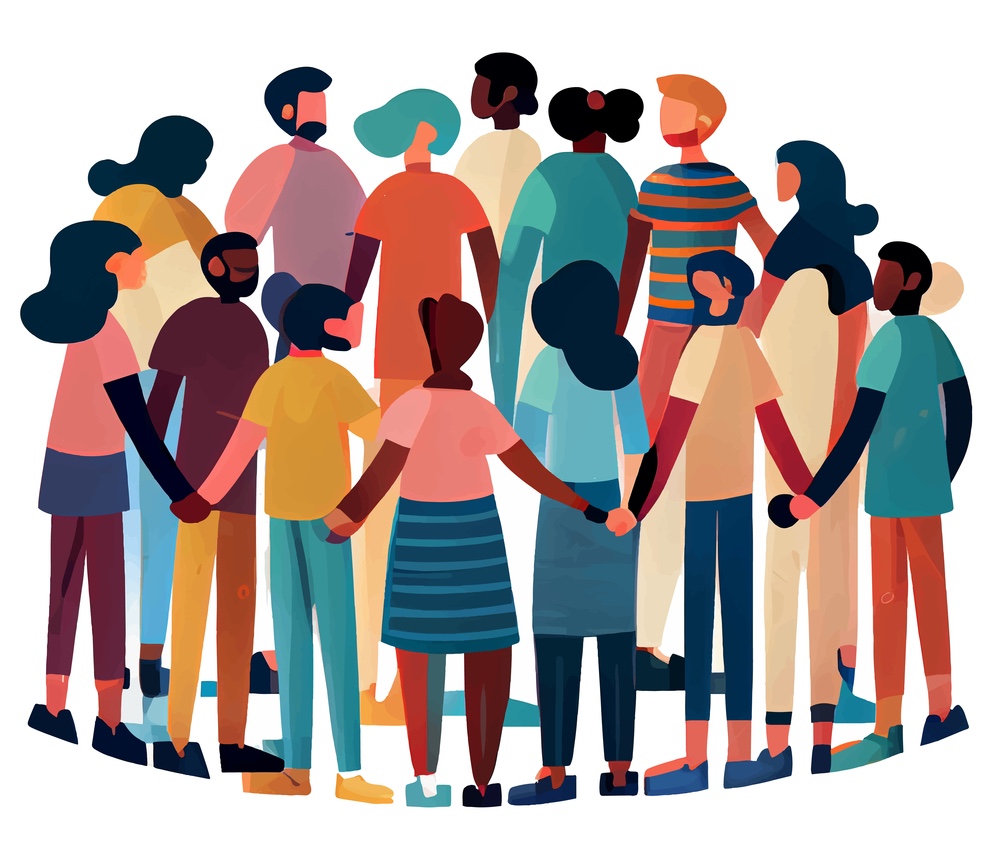
Throughout the program, I began to open up about my struggles, and I was met with compassion and understanding. There was space held for me and my pain of isolation, along with the understanding of how this happens to some groups. It was in this sacred space that we came together and fellowshipped. It was then that I realized I was not meant to walk this path alone. No one is. It was in this environment that I allowed myself to be vulnerable and access my authenticity. I learned what it meant not only to be a Black woman but also to be me.
As people of color, we have the unique experience of operating in a country where we are marginalized, suppressed, and made to appease White society. The work becomes finding ourselves and gaining the power that was unfairly taken from us. This cannot happen alone. We must be in community. We must find others who have similar experiences and walk alongside them. We must put ourselves in spaces that foster our authenticity and celebrate our uniqueness. To cultivate these safe spaces, I have a responsibility to the We. I have to be willingly vulnerable within these safe spaces. I have to let myself be seen. This is what my community continues to teach me. I have finally come back to myself and let that be enough. I have centered myself and my communities’ lived experiences. When we are put in environments that emphasize social justice and diversity, we are all liberated. Every professor I learn from, every student that I meet, and every client I support continue to show me how important it is to remain true to myself. This is my greatest power, and it will continue to strengthen in supportive environments.
Environments that strengthen your voice
Dr. Kenneth Hardy (2013) coined the term assaulted sense of self, a description of an experience people of color know all too well, especially in academic settings. Assaulted sense of self “is recurring experiences that lead to internalized devaluation” (Hardy, 2013, p.25). Through this lens, we can develop a form of voicelessness, a feeling personified through our silencing, code-switching, and minimizing of our perspectives, internalizations, all within systems that continue to perpetuate an imbalance and unspoken expectations. It seems we are left with two choices: to lean into this voicelessness, or act as the voice for this part of your identity in a room full of people who would not dare to name the imbalances that exist due to the systems that uphold whiteness. These environments can lead to systemic biases, feeling alone and unsupported, oversaturation of Eurocentric curricula, policing of experiences, all in a setting where you should feel welcomed to be curious, name differences, and feel seen.
When presented with an opportunity to see professors, classmates, and folks in your communal spaces who reflect parts of us, something begins to shift. We begin to find a sense of belonging and reconnect with our voice and the value it can hold. There is power in the way we show up uniquely and comfortably without the pressure to perform or lean further into our voicelessness. These environments help shape safety, trust, and vulnerability. These environments enhance future voices. When the curriculum is inclusive and celebrates cultural differences, something settles, allowing you to hear a glimmer of experiences that feel similar. When authors like bell hooks are a part of learning feminist theory or books like The Pain We Carry are a part of our required readings, the system can evolve from unintentionally silencing to amplifying deeper understandings and cultivating a true learning environment.
Importance of your voice and what to do when you find it
Being able to speak for oneself is a form of advocacy in and of itself. As such, finding your voice is a trait that is essential for MFTs. To claim a systemic framework without a form of advocacy seems counterintuitive, as many of the issues both our clients and we face are rooted in systemic injustices. If we are not capable of advocating for ourselves, how can we reliably advocate for others? Through community found within academic spaces, advocacy can and should be discussed, modeled, and practiced in such a way that students become comfortable and proficient in using their voices as budding practitioners. When we use our voices, we are able to create and/or modify spaces within academic and professional organizations that have historically been suppressed or oppressed for our identities.
Advocating for oneself requires a host of skills that is essential for the average MFT—the ability to express oneself clearly, the willingness to challenge and question the status quo, and the ability to repair relationships. Most difficult, however, is the self-of-the-therapist work that comes with finding one’s voice. Understanding the self requires curiosity about one’s lived experiences and questioning the outcome of such. It requires challenging internalized thoughts, feelings, and fears. Doing so is hard, albeit necessary to finding a voice.
Conclusion
The future of our field needs you, your ideas, and your voice. There are many resources to help students discover and solidify their professional identity and space in the field like the book Finding Your Voice as a Beginning Marriage and Family Therapist and multiple FTM articles like “Increasing Belongingness for the Future of MFT Programs, the Field, and the Association.” This professional journey should not be done in isolation. Become active in the field, network with your peers and professors, and cultivate community that makes you feel like you are enough.


Alejandra Franco, LMFT, is a doctoral student. Her clinical interests are with the Latinx population, especially First-Gen and oldest daughters.

Leilanis Cancel-Lopez, MS, is a first-year PhD student in Adler University’s Couple and Family Therapy program and a Student member of AAMFT. After graduating from Florida State University with a BS in Human Development and Family Science, she attended Northern Illinois University for her Master’s in Marriage and Family Therapy. As an immigrant from Puerto Rico, Leilanis understands the importance of creating a supportive family environment. As such, Leilanis focuses on working with family systems, especially those in the midst of raising adolescents.

Inkera Muwwakkil, MA, ALMFT, is a current PhD student at Adler University, a Professional member of AAMFT, and currently works as a clinical therapist at Hollie Therapy and Counseling. Her main areas of focus clinically are working with people of color. She plans to continue to serve these communities and search for ways to improve their well-being and help others understand the importance of adding to the work we continue to do.

Faven Simmons is a Student member of AAMFT. She is completing her master’s degree in Couple and Family Therapy at Adler University and will continue her training in Adler’s PhD program in Couple and Family Therapy. Faven is a practicing clinician on the north side of Chicago, where she provides relational, culturally responsive care to individuals, couples, and families. Her professional interests include clinical practice, teaching, and advancing research within the field.

DeAnna Harris-McKoy, PhD, is a licensed marriage and family therapist, AAMFT Professional member holding the Clinical Fellow and Approved Supervisor designations, and a social justice advocate. She is currently an Associate Professor and Specialization in Marriage and Family Therapy Program Director at Northern Illinois University.
Gondos, C. S., Piracci, G., Casati, M., Castellari, E., Varacca, A. (2026). Impostor syndrome as a driver of burnout: a Bayesian latent trait analysis among early-career researchers. Q Open, 0(0), p1-21. https://doi.org/10.1093/qopen/qoag014.
Hardy, K. V. (2013). Healing the hidden wounds of racial trauma. Reclaiming Children and Youth, 22(1), p. 24-28.
Other articles


The Abrupt Stop: The Hidden Grief of Losing an Athletic Identity
Being an athlete often becomes more than competition. For many athletes, sport provides identity, structure, belonging, relationships, and purpose. When an athletic role ends unexpectedly or without adequate preparation, individuals may experience grief, identity disruption, and changes within their relational systems.
Lilach Harris, MFT, and Jordan Sinness, BS

Love Isn’t Failing; Your Attachment System Is The Science Behind “Overreacting”
Couples don’t break up because they argue. They break up because they feel alone while arguing.
Carlota Azpiazu Osorio, MA

Finding Meaning in the Midst of Grief
Grief is a universal human experience, yet it rarely looks the same from one person to another. Although we often associate grief with the death of a loved one, loss can take many forms: the end of a relationship, a shift in identity, a dream that no longer feels possible, or a future that suddenly looks different from what we once imagined.
Melissa Benton-Hebert, MA