
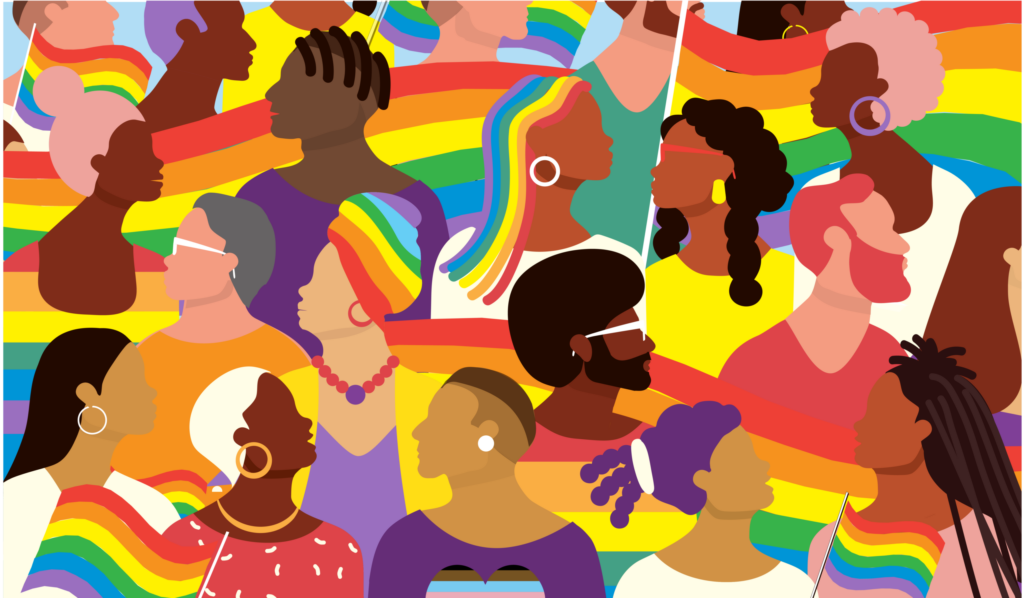
Pride asks us to celebrate queer people in June. The rest of the year asks us whether we actually mean it.
June is over. Across the country, Pride flags have come down from storefronts. Performers have been paid, confetti swept away, and rainbow-themed swag packed up for use next year. Corporations have returned their logos to their usual branding after a month of multicolored celebration.
As Pride recedes from the cultural spotlight, queer people become less visible and less celebrated in mainstream spaces. But queerness does not become less relevant to queer people on July first (Day, 2022). If anything, the end of Pride offers an opportunity to ask a more important question:
What does it mean for marriage and family therapists to support queer clients when supporting queerness is no longer fashionable?
The paradox of pride
Patches across the quilt of the United States have gotten fairly good at celebrating queerness. Cities like San Francisco, Denver, and New York (to name a few) throw extravagantly queer parties that loudly proclaim the legitimacy of queerness across their cities. Some parts of the United States are less lucky. For LGBTQ people living in some rural areas, discrimination and stigma can be woven into the ordinary fabric of community life (Wike, 2022).
Where Pride is celebrated, we see meaningful community improvements. We become more familiar with queer language and culture, learn the do’s and don’ts of interacting with queer people, and sometimes remember that queerness is not a singular experience, but a layered identity refracted through the prism of someone’s other identities.
Although we’ve made some progress in the way we celebrate the queer experience, we have made less progress in protecting queer people (Andrew et al., 2026). In some communities, even basic support remains out of reach.
We have not yet fully connected celebration with solidarity.
June also ratchets up the visibility of queer people while corporations rake in money selling rainbow-themed clothing, water bottles, and just about anything else that can be made in six colors (Bennett et al., 2014). But when visibility isn’t accompanied by investment that creates meaningful systemic change, celebration becomes performance. We have not yet fully connected celebration with solidarity.
Visibility may increase during Pride, but resources and meaningful support for queer communities do not necessarily increase with it. And when they do, that support can disappear almost as quickly as June ends.
And then there are the other 11 months
What happens when the rainbows disappear?

Do practices maintain and regularly update inclusive websites, paperwork, bathrooms, and referral networks? Do we continue talking about queer families when our newsletters move on to other topics? Do we continue to critically examine our practices and our interactions with queer clients throughout the year?
Or does our commitment to queer clients become little more than the progress flag pinned to our office door?
In any other political climate, I would still encourage MFTs to keep doing the work: attend queer-centered continuing education courses and examine your own biases; understand that simply being queer does not make you an effective queer clinician; refresh your bulletin board with queer-affirming resources; and do the research to make sure those resources are accurate, current, and accessible (Vasic, 2025).
These things are wonderful, essential steps that move. But in this particular political climate, it is not enough.
Our allyship has to become action rather than an identity. It cannot simply be something we call ourselves or communicate through the rainbow on our website.
We need to pay attention to the greatest threats and tune into the needs of the most vulnerable members of the queer community, particularly transgender people.
Right now, being a queer-affirming therapist means more than creating a welcoming office. It means understanding what is happening to queer people and asking ourselves what, concretely, we are willing to do about it.
The particular vulnerability of the transgender community


In the US, trans people have experienced an unprecedented increase in targeting, scapegoating, and political attacks, despite being everyday Americans going about their lives (Cannon, 2022). Legislation such as Kansas requiring driver’s licenses to reflect sex assigned at birth, along with bans on gender-affirming medical care for transgender youth across the country (ACLU of Kansas, 2026) are just a few examples of the ongoing efforts to silence the community.
These laws targets a population that has increasingly been positioned as a political problem rather than recognized as a community of people.
And sometimes, without realizing it, we might begin to internalize the messages being directed at us from every angle of the current US administration and the broader international political climate. We may become more hesitant in our language, more cautious in our practice, or more likely to question whether we are somehow “going too far” in supporting transgender clients (Cutillas-Fernandez et al., 2023).
We have to be clear with ourselves, and with one another, that political backlash does not mean transgender people have become less worthy of support. It does not mean their identities have become less legitimate. And it certainly does not mean that clinicians should become less willing to provide affirming, competent care.
It means that clinicians need to be prepared to do more.
How clinicians can internalize these messages
As systemic therapists, we are trained to think beyond the individual. We consider relationships, families, communities, culture, and the broader systems that shape our clients’ lives.
When we work with queer clients, that systemic lens requires us to take context seriously. A queer person’s experience does not exist in a vacuum, and identity is inevitably shaped by the world around them.
Being a trans person in the state of Colorado, for example, can carry very different realities than being a trans person in Kansas. The laws, political climate, community resources, social attitudes, and level of safety available to each person become part of the system in which therapy takes place. (ACLU of Kansas, 2026).
We also have to consider how identity affects relationships and access to resources. Queer people may experience minority stress, discrimination, rejection, or isolation, all of which can affect mental health and relationships (Amos et al, 2023; Bochiccio et al, 2022). At the same time, queer identity can also be a source of community, connection, resilience, and joy (Joseph, 2021).
These contextual factors change how we understand our clients’ experiences, which means they should also change how we conceptualize and deliver therapy.
And if we are willing to change our clinical conceptualization based on the systems and context surrounding our clients, we also have to take a closer look at one of the foundational stances of the MFT profession: neutrality.
Neutrality can be an important clinical tool. It can help therapists remain curious, avoid imposing their own values, and make space for multiple perspectives within a system.
But neutrality becomes more complicated when the perspectives within that system do not carry equal power (Coolhart, 2018).
For example, imagine a queer client and a family member who hold very different views about the client’s identity. Treating both positions as equally valid may appear neutral, but it can unintentionally obscure the fact that those positions do not carry equal weight in the world.
The therapist may be trying to remain neutral, but the larger system is not neutral.
Social, cultural, and political forces are already influencing whose perspective is considered legitimate, whose identity is affirmed, and whose safety is protected. And often, the marginalized client is the person who ends up carrying the cost.
This means that systemic thinking has to include power.
Power isn’t neutral, nor will it “just go away” if we ignore it long enough.I created a lens of therapy that adjusts the neutrality of the therapist for this reason: the Queer Adjusted Systemic Lens (QASL).
The QASL is not asking therapists to abandon systemic thinking or to simply “take the queer client’s side.” It is asking us to recognize that power is part of the system, too.


This means the therapist’s role is not to be neutral about whether someone’s queerness is valid. The role is to remain curious, thoughtful, and systemic while recognizing that neutrality can unintentionally reinforce the very inequities we are trying to understand.
What can I do?
This is usually the point in a training or class when a participant inevitably asks, “So, what can we do about it?”
You may be asking the same question as you read this article.
Recognizing the ways that neutrality, power, and context shape our work with queer clients is important, but awareness alone is not enough. Knowing needs to be combined with action for awareness to be at all meaningful (Vasic, 2025).
There are many ways, both inside and outside the therapy room, that therapists can put this into practice and move beyond simply “supporting” queer clients toward actively creating more affirming, responsive systems.
And importantly, this work is not limited to Pride Month. There are concrete ways to celebrate, support, and advocate for queer communities all year long.
In the Therapy Room
1. Carefully consider how you use neutrality when engaging with queer clients.
Do you notice moments in sessions where you may have missed an opportunity to affirm someone? Did you unintentionally elevate someone else’s experience or emotions over the experience of a queer client? Are there moments when you could have elevated queerness and taken a session in an entirely different direction?
2. Review your paperwork and language.
How are you asking about gender identity and sexual orientation? Are there places where you unintentionally contribute to heteronormative messages, including through the types of clients depicted in photos on your website? Do you have opportunities to make your commitment to queer-affirming therapy clearer in your office or your marketing materials?
3. Consider your client resources.
Do you know specific clinicians to whom you can confidently refer queer clients? What are the queer advocacy and community-building organizations in your area? Are you readily able to provide that information to clients?
Outside the therapy room
1. Support queer publications.
Buy books by queer authors or borrow materials from the public library, and recommend authors you like to those in your community.
2. Elevate queer voices.
Follow queer clinicians, writers, artists, educators, and activists on social media, and interact with their materials to increase their visibility. Pay queer creators when you can.
3. Donate to or volunteer with queer-led organizations.
Your local queer community centers are constantly in need of financial and people-power resources.
Reframing pride
Rather than ending with doom, I’d bring it back to Pride itself.
Perhaps we should redefine Pride. Instead of a once-a-year event, maybe it should be a once-a-year reminder.
A reminder to reevaluate our therapeutic practices and examine how we interact with queerness, both as therapists and as people moving through the world. A moment to pause, take a deep breath, and reorient ourselves to the context of our clients. To ask what we are noticing, what we may be missing, and how our own understanding of neutrality fits within a world that is decidedly not neutral.
It can also be a time to check the durability of our queer-affirming practices and systems.
Are they built into the way we actually work, or do they depend on individual people, good intentions, or the particular moment we happen to be in? Would our practices remain affirming when circumstances become more difficult? Are our policies, language, training, and clinical practices designed to support queer clients consistently, not just when it is easy to do so?
Pride can be more than a month on the calendar. It can be an annual invitation to look again at our work, our assumptions, and our systems, and to ask whether the affirmation we offer is not only visible, but tangible and durable.


August Tousignant-Stanton (they/them), MSW, is a licensed marriage and family therapist and a licensed clinical social worker. They are an AAMFT Professional Member holding the Clinical Fellow and Approved Supervisor designations and serve as the Program Director at Denver Family Institute (DFI), as well as the Program Lead for DFI’s Systemic Provider Training for Queer Youth Clients. August also owns a private practice, Affirming Psychotherapy LLC, in Denver, Colorado, United States, where they specialize in queer youth and their families, all types of neurodiversity, epilepsy and NES, and polyamorous/non-monogamous relationships. August is the creator of the Queer Adjusted Systemic Lens and has presented to American and international audiences, including at AAMFT’s National Conference in 2025. August authored the “Children” chapter in Gender Affirming Care: Guidelines for Working Systemically with Transgender, Nonbinary, and Gender Expansive Clients and is the recipient of the 2024 Rocky Mountain Family Therapy Network’s Local Advocacy Award.
ACLU of Kansas. (2026, February 27). Understanding the new Kansas law targeting transgender people. https://www.aclukansas.org/publications/sb244faq/
Amos, N., Hill, A., Lyons, M., Bigby, C., Carman, M., Parsons, M., & Bourne, A. (2023). Factors associated with experiences of harassment or abuse among lesbian, gay, bisexual, trans, queer, and asexual young people with disability in Australia. Journal of Interpersonal Violence. https://doi.org/10.1177/08862605231216690
Andrews, E. E. E., Campbell, S., Bryant, E. A., & Lee, M. F. (2026). A compass towards competency: Mapping LGBTQIAP+ inclusive healthcare training: A scoping review. Journal of Homosexuality. Advance online publication. https://doi.org/10.1080/00918369.2026.2711861
Bennett, A., Taylor, J., & Woodward, I. (Eds.). (2014). The festivalization of culture. Routledge.
Bochicchio, L., Reeder, K., Ivanoff, A., Pope, H., & Stefancic, A. (2022). Psychotherapeutic interventions for LGBTQ + youth: a systematic review. Journal of LGBT Youth, 19(2), 152–179. https://doi.org/10.1080/19361653.2020.1766393
Cannon, L. (2022). The politicization of trans identity: An analysis of backlash, scapegoating, and dog-whistling from Obergefell to Bostock. Lexington Books.
Coolhart, D. (2018). Helping families move from distress to attunement. In C. Keo-Meier & D. Ehrensaft (Eds.), The gender affirmative model: An interdisciplinary approach to supporting transgender and gender expansive children (pp. 125–140)
Cutillas-Fernández, M. A., Jiménez-Barbero, J. A., Herrera-Giménez, M., Forcén-Muñoz, L. A., & Jiménez-Ruiz, I. (2023). Attitudes and beliefs of mental health professionals towards trans people: A systematic review of the literature. International Journal of Environmental Research and Public Health, 20(15), 6495.
Day, C. R. (2022). The rainbow connection: Disrupting background affect, overcoming barriers and emergent emotional collectives at “Pride in London.” The British Journal of Sociology, 73(5), 1006–1024
Dürrbaum, T., & Sattler, F. A. (2020). Minority stress and mental health in lesbian, gay male, and bisexual youths: A meta-analysis. Journal of LGBT Youth, 17(3), 298–314.
Golden, R. L., & Oransky, M. (2019). An intersectional approach to therapy with transgender adolescents and their families. Archives of Sexual Behavior, 48(7), 2011–2025.
Joseph, C.G. (2021). Swann, William Dorsey (Mar. 1860-c.23 Dec. 1925), drag queen, activist, and leader of an early Black queer organization. Oxford African American Studies Center.
Malpas, J., Pellicane, M.J., Glaeser, E. (2022). Family-based interventions with transgender and gender expansive youth: Systematic review and best practice recommendations.
Vasic, S., Pope, A. L., Adams, J., Snowden-Gregg, S., & Augustine, B. R. (2025). “Queer Futures”: Toward LGBTQ+ Responsive Counselor Preparation. Journal of LGBTQ Issues in Counseling, 19(4), 425–446. https://doi.org/10.1080/26924951.2025.2456299
Wike, T. L., Bouchard, L. M., Kemmerer, A., & Yabar, M. P. (2022). Victimization and Resilience: Experiences of Rural LGBTQ+ Youth Across Multiple Contexts. Journal of Interpersonal Violence, 37(19–20), NP18988–NP19015.
Other articles


Silencing Impostor Syndrome by Cultivating Community to Strengthen Your Voice In an MFT Program
Becoming a marriage and family therapist (MFT) can be intense and challenging, yet transformational when you find community and are in supportive environments. This article is written by four doctoral students and an associate professor to acknowledge the challenges of being a student, while providing hope and encouragement to the journey.
Leilanis Cancel-Lopez, MS, Alejandra Franco, MA, Inkera Muwwakkil, MA, Faven Simmons, and DeAnna Harris-McKoy, PhD

The Abrupt Stop: The Hidden Grief of Losing an Athletic Identity
Being an athlete often becomes more than competition. For many athletes, sport provides identity, structure, belonging, relationships, and purpose. When an athletic role ends unexpectedly or without adequate preparation, individuals may experience grief, identity disruption, and changes within their relational systems.
Lilach Harris, MFT, and Jordan Sinness, BS

Love Isn’t Failing; Your Attachment System Is The Science Behind “Overreacting”
Couples don’t break up because they argue. They break up because they feel alone while arguing.
Carlota Azpiazu Osorio, MA