

An autistic client sits quietly as their therapist asks another question. The client does not respond. Is the client disengaged? Avoiding the topic? Unable to identify what they are feeling? Or is something happening in the interaction that the therapist has not yet noticed?
For marriage and family therapists (MFTs), the question is not simply what is happening within the client. It is also what is happening between people.
Autism is a spectrum, and autistic clients differ widely in communication, sensory experience, emotional expression, support needs, strengths, and capacity across settings. There is no single autistic way of communicating, relating, regulating, or participating in therapy. The same person may communicate differently with a partner than with a parent, differently at work than at home, or differently when regulated than when overwhelmed.
Observable behavior, therefore, does not always tell us what is happening internally—or what is happening within the relationships and systems surrounding the person.
The question becomes not only, ‘What is happening within this client?’ but also, ‘What is happening between this client and the people, relationships, and environments around them?’
Systemic thinking invites MFTs to examine the reciprocal patterns, contexts, and relationships in which difficulties emerge and are maintained. An autistic adult who becomes quiet during therapy may be overwhelmed by the pace or demands of the interaction rather than resisting treatment. An autistic adolescent described as “inflexible” at home may be responding to a particular family interactional pattern. For example, a client who communicates effectively in one setting may lose access to speech in another. The question becomes not only, ‘What is happening within this client?’ but also, ‘What is happening between this client and the people, relationships, and environments around them?’
When the problem is located only in the individual
One of the risks in autism-informed therapy is not what clinicians observe, but what we assume those observations mean.
A client avoids eye contact, and the behavior is understood as disengagement. A client becomes quiet, and the silence is interpreted as resistance or avoidance. A client needs more time to respond, and the delay is viewed as limited insight or difficulty participating in therapy.
Once an interpretation is made, it can quickly shape the therapist’s response—and that response can influence what happens next.
Research on autistic adults’ experiences of mental health therapy suggests that misunderstandings around communication, therapist expectations, and the structure of therapy can make treatment more difficult to access and engage in (Crane et al., 2019; Mazurek et al., 2023).
The concern is not that clinicians should stop interpreting behavior.
Interpretation is part of clinical practice. The concern is what happens when an interpretation becomes a conclusion before the clinician has considered relational and contextual possibilities.
Consider an autistic client who becomes increasingly quiet during an emotionally intense session. The therapist might wonder whether the client is anxious, overwhelmed, avoiding the topic, dissociating, processing information, or temporarily losing access to spoken language. A systemic formulation extends the inquiry: ‘What is happening around the silence?’
What happened immediately before the client became quiet? What was being asked of them? How was the conversation unfolding? What expectations about communication were operating in the room? Does a similar pattern occur in the client’s family, partnership, workplace, or other relationships? How do others typically respond when the client becomes quiet?
These questions do not require the therapist to assume that every behavior has a relational explanation. They create space for multiple hypotheses before assigning meaning to the behavior.
That distinction is central to systemic practice. Instead of asking only, ‘What does this behavior tell me about the client?’, MFTs can also ask, ‘What does this behavior tell me about the interaction, the context, and the system in which it is occurring?’
The therapy relationship is part of the system
Systemic thinking asks clinicians to consider not only what a client brings into therapy, but what develops between people in the therapy room. The therapist is not a neutral observer standing outside the interaction. The therapist’s observations, interpretations, questions, and responses become part of the relational process, which in turn shapes how the client responds.
This matters when working with autistic clients because an interpretation can quickly become part of a recursive interactional pattern:
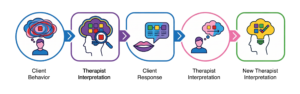 Imagine an autistic adolescent who becomes distressed when a session shifts unexpectedly to a new topic. The therapist interprets the reaction as resistance and responds by asking more questions or pressing for greater verbal disclosure, while the client becomes increasingly overwhelmed and disengaged. The client experiences the increased pressure as overwhelming and communicates even less. The therapist observes greater withdrawal and interprets it as further evidence of avoidance.
From a systemic perspective, the important question is not simply whether the client is avoiding the conversation. It is: ‘What is happening in the interaction that may be contributing to the client’s difficulty communicating?’
The therapist might slow the pace, allow additional processing time, offer written or visual communication, reduce sensory demands, or ask how the client prefers to communicate when speech becomes difficult.
These changes do more than accommodate an individual client. They alter the interactional conditions under which the problem is occurring.
This is one of the distinctive contributions MFTs can bring to autism-informed care. MFT training centers relational processes, reciprocal influence, interactional patterns, and the contexts in which individual experiences unfold. The MFT is therefore positioned to consider not only how an autistic client might adapt, but also how relationships, environments, and interactional sequences may participate in maintaining or changing a difficulty.
What MFTs bring to autism-informed care
The systemic foundation of marriage and family therapy offers a particularly relevant framework for autism-informed practice. COAMFTE standards emphasize a systemic understanding of individuals within relational and contextual environments, providing MFTs with a professional lens that extends beyond an exclusively individual formulation (Commission on Accreditation for Marriage and Family Therapy Education [COAMFTE], 2021).
Autism-specific MFT literature supports the relevance of this perspective. Neely et al. (2012) identified potential contributions of MFTs working with families living with autism, including attention to relational challenges across the family life cycle. Helps (2016) described systemic psychotherapy as a way of understanding autism-related difficulties within family relationships and broader interactional contexts. More recent systemic work has continued to explore interventions that address family dynamics, communication, and relational patterns rather than locating difficulty exclusively within the autistic person (Pennant, 2025).
The contribution is not simply that MFTs work with families. Other mental health professionals also work with couples and families. The distinctive contribution is the systemic conceptualization MFTs bring to clinical decision-making: attention to reciprocal influence, patterns that maintain problems, relational meanings, and multiple locations for change.
This distinction remains important when an autistic client attends individual therapy. An individual session does not remove the client from their relational world. The client remains connected to partners, family members, friends, workplaces, communities, and other systems that influence their experiences and responses. MFTs can therefore hold two ideas at the same time: the autistic person’s individual experience matters, and that experience cannot always be fully understood apart from the relationships and contexts in which it occurs.
From individual focus to systemic practice:
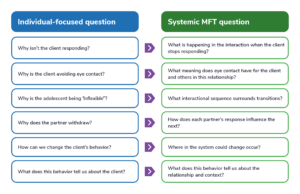
Look at the relationship, not just the behavior
The systemic lens becomes especially useful when autistic clients and their partners or family members assign different meanings to the same behavior.
Consider an autistic partner who becomes unusually brief during a conversation about conflict. Their partner interprets the change as anger or emotional withdrawal and begins asking increasingly direct questions. As the pressure increases, the autistic partner communicates even less. Their partner interprets the silence as rejection and begins asking for reassurance. The autistic partner experiences the increased verbal demand as overwhelming and withdraws further. The partner then experiences the withdrawal as confirmation that something is wrong in the relationship.
An individual formulation might focus on the autistic partner’s communication or the other partner’s anxiety. A systemic formulation asks what happens between the partners and how each person’s response influences the next.
The MFT can help the couple identify the sequence, explore the meanings each partner assigns to the other’s behavior, and experiment with changes in communication that alter the cycle. The goal is not to determine which partner is responsible, it is to understand the pattern well enough to identify where meaningful change is possible.
The same principle applies in family therapy. An autistic adolescent may be described as “inflexible” because transitions frequently lead to conflict. A systemic formulation examines the sequence. Perhaps a parent announces a transition with little warning. The adolescent becomes distressed and resists. The parent repeats the demand more forcefully.

The adolescent escalates, and the parent interprets the escalation as oppositional behavior. Asking only ‘How do we make the adolescent more flexible?’ misses part of the clinical picture. The systemic question becomes: ‘What interactional sequence is occurring, and where within that sequence might meaningful change occur?’
The answer may still include helping the adolescent develop coping, communication, or transition skills. It may also involve increasing predictability, changing how transitions are introduced, helping parents recognize early signs of overwhelm, or shifting the family’s response once distress begins.
The goal is not to decide whether the individual or the system is “the problem.” The goal is to understand the pattern well enough to identify where change can occur.
Whose goal is it?
Systemic thinking also raises an ethical question that can be easy to overlook: ‘Whose goal is this?’
When therapy involves an autistic client, treatment goals may emerge from several people and systems at once. A parent may want fewer meltdowns. A partner may want more communication. A school may want greater flexibility. A clinician may want to reduce a behavior that appears to interfere with functioning. The client may have an entirely different priority.
For MFTs, this is not simply a matter of choosing one person’s preference over another’s. Our systemic responsibility is to understand how these perspectives fit within the larger relational system and to work collaboratively toward goals that support client and relational well-being. The AAMFT Code of Ethics emphasizes the well-being of clients and the profession while also identifying advocacy, public participation, and equitable access to mental healthcare as responsibilities of marriage and family therapists (AAMFT, 2026). This becomes particularly important when an autistic characteristic is targeted for change because it makes other people uncomfortable.
Research examining autistic adults’ perspectives on behavioral intervention goals found greater acceptance of goals emphasizing quality of life and safety than goals focused on normalization according to neurotypical standards (Baiden et al., 2025). This does not mean clinicians should avoid addressing behaviors that create genuine distress, interfere with functioning, or present safety concerns. Instead, it asks us to examine why a goal is being pursued, who identified it, and who benefits from the change.
Consider an autistic adult who has been encouraged to make more eye contact because family members, partners, or professionals interpret limited eye contact as disinterest. The clinical question is not simply whether eye contact can be increased. The therapist can explore what the client wants from their relationships, how eye contact affects the client, how others interpret it, and whether there are other ways to support connection and communication.
Sometimes the ethical intervention is helping the autistic client develop a new skill. Sometimes it is changing a family interaction.
Sometimes it is helping a partner understand a different form of communication. And sometimes it is recognizing that a behavior does not need to be eliminated at all.
A systemic approach asks us to keep returning to the same question: ‘Are we helping this person become more able to live the life and relationships they want, or are we primarily helping the surrounding system become more comfortable with the way they are?’

Systemic reflexivity includes the therapist
If systemic thinking asks us to examine patterns of reciprocal influence, then the therapist cannot stand outside the system and assume that our observations are neutral.
Therapists bring assumptions into every interaction. We hold expectations about communication, emotional expression, independence, reciprocity, relationships, and what productive therapy should look like. Those expectations influence what we notice, what we interpret as a problem, and how we respond.
With autistic clients, those assumptions can be particularly important when neurotypical ways of communicating or relating are treated as clinical standards.
Before labeling a behavior as resistance, avoidance, disengagement, or lack of insight, the MFT can pause and ask:
‘What am I assuming this behavior means?’
‘Would I interpret it differently if the client were not autistic?’ ‘What is happening in the interaction that might be contributing’
‘Am I responding to the client’s distress, or to my own discomfort with unfamiliar behavior?’
‘Am I asking the client to adapt to therapy without considering how therapy could adapt to the client?’
This kind of reflection does not require abandoning clinical judgment. It requires recognizing that our interpretation becomes part of the relational system we are trying to understand.
A shift in the therapist’s interpretation can lead to a shift in the therapist’s response, which can create a different interactional pattern altogether.
Bringing systemic thinking into practice
Autism-informed therapy does not require MFTs to abandon the therapeutic models they already use. MFTs may practice from narrative, experiential, cognitive-behavioral, or other modalities while maintaining a systemic way of conceptualizing relationships, context, and patterns.
A practical starting point is to move through six questions:
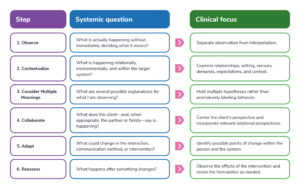
The process is not strictly linear; reassessment can return the therapist to observation as new information emerges. This approach allows MFTs to maintain clinical structure while remaining flexible about how therapy is delivered. It also keeps attention on the interaction between the person and the systems around them rather than assuming that every difficulty must be corrected within the individual. For MFTs, this is not a departure from our systemic identity. It is an application of it.
Autism-informed practice asks us to look carefully at the person in front of us while also asking what relationships, expectations, environments, and interactional patterns are shaping what we see.
Sometimes meaningful change will occur within the individual. Sometimes it will occur within a couple relationship, family interaction, or broader environment. Sometimes the most important change begins within the therapeutic relationship itself.
The systemic question is therefore not only ‘What does this client need to change?’ It is also: ‘What needs to change around this client?’
That question does not minimize the individual. It places the individual back within the relational world where therapy—and life—actually occur.
photo credits istock: stellalevi

Kristina Betz, LMFT, CAS, ASDCS, CMNCS, is a licensed marriage and family therapist at Integrated Therapy Services Northwest, where she specializes in autism-informed and neurodiversity-affirming mental health practice. She earned her master’s in marriage and family therapy from Seattle University. Her clinical work includes autistic adolescents and adults and focuses on relationships, identity, anxiety, trauma, and adapting psychotherapy to meet the needs of neurodivergent clients. Her work emphasizes systemic conceptualization, therapist reflexivity, ethical clinical practice, and relational approaches to autism-informed care. She is an AAMFT Professional member working toward the Approved Supervisor designation.
American Association for Marriage and Family Therapy. (2026). AAMFT code of ethics. https://www.aamft.org/AAMFT/Legal_Ethics/Code_of_Ethics.aspx
Baiden, K. M. P., Williams, Z. J., Schuck, R. K., Dwyer, P., & Wang, M. (2025). The social validity of behavioral interventions: Seeking input from autistic adults. Journal of Autism and Developmental Disorders, 55(4), 1172–1186. https://doi.org/10.1007/s10803-024-06297-3
Commission on Accreditation for Marriage and Family Therapy Education. (2021). Accreditation standards version 12.5. American Association for Marriage and Family Therapy.
Crane, L., Adams, F., Harper, G., Welch, J., & Pellicano, E. (2019). “Something needs to change”: Mental health experiences of young autistic adults in England. Autism, 23(2), 477–493. https://doi.org/10.1177/1362361318757048
Helps, S. (2016). Systemic psychotherapy with families where someone has an autism spectrum condition. NeuroRehabilitation, 38(3), 223–230. https://doi.org/10.3233/NRE-161314
Mazurek, M. O., Pappagianopoulos, J., Brunt, S., Sadikova, E., Nevill, R., Menezes, M., & Harkins, C. (2023). A mixed methods study of autistic adults’ mental health therapy experiences. Clinical Psychology & Psychotherapy, 30(4), 767–779. https://doi.org/10.1002/cpp.2835
Neely, J., Amatea, E. S., Echevarria-Doan, S., & Tannen, T. (2012). Working with families living with autism: Potential contributions of marriage and family therapists. Journal of Marital and Family Therapy, 38(Suppl. 1), 211–226. https://doi.org/10.1111/j.1752-0606.2011.00265.x
Pennant, A. (2025). SFT for ASD: A systemic intervention for neurodiverse families. Journal of Family Therapy, 47(1), e12475. https://doi.org/10.1111/1467-6427.12475
Other articles

Feature
Multidisciplinary Supervision: Ethical Considerations Between Client Autonomy in Reproductive Decision-Making and ‘No Secret-Keeping’ in Couples Therapy
Marriage and family therapists (MFTs) working in multidisciplinary settings have unique opportunities to collaborate, learn, and contribute to a shared goal of providing quality patient care. Within multidisciplinary teams, professionals and trainees balance different training backgrounds, different languages, and different ethical codes across disciplines in their decision-making process.
Gabrielle C. Gebel, PhD Tyler Fleming, DO, and Jessica Goodman, PhD

Feature
Renewal Without Relationship: The Quiet Erosion of Marriage and Family Therapy
A flyer came in the mail last month, addressed to my practice. Glossy, four colors, the kind of mailer most of us toss without a second look. Across the top, in letters two inches tall: MARRIAGE & FAMILY THERAPIST LICENSE RENEWAL CE SALE. Each selection $29.99. No limits. Buy as many as you need to fulfill your requirements.
John Souza, Jr., DMFT

Feature
Human-AI Synthetic Relationships and Digisexuality: A Systemic Approach: Part I
As two Gen X therapists, albeit brought up in different countries, we (MLCT and AI) remember both the excitement and fear of new technologies and computing advances, particularly in the 1980s. Movies like Tron, War Games, Electric Dreams, Weird Science, Terminator, and Blade Runner, to name but a few, exemplified both the pervasive fear of computers becoming sentient, and the thrill of possibility brought on by the computer revolution.
Markie L. C. Twist, PhD, and Alex Iantaffi, PhD