

No matter what side of the political spectrum you find yourself, I think all will agree that the past year has been a roller coaster ride in United States (US) politics. Politics have ranged from usual polarizations, arguments, and stuck positions, to abuse, killings, overt racism, and heightened policing, to name a few. The recent events in Minnesota, which resulted in US citizens being killed in the streets, have left indelible images in our hearts and minds. These are all added to the many other images of tragedy depicted in the US and around the world in recent times. There are many instances when we may end up feeling helpless, unsure as to how we can make meaningful changes in our world. There are things we are very good at as MFTs that can make an impact on the larger systems in which we live.
We excel at working with systems, polarizations, high conflict, trauma, and heightened emotions. The polarizations that exist in US politics are not new; they have been there for years. However, they are growing worse. Here are a few ideas to consider at a personal, local, and national level. I would like to use the example of two different kinds of family systems as a way to contrast our role in the larger system of US politics.
FAMILY ONE
The first family system to consider is one that is tense, finger-pointing, angry, and polarized. Family members are not getting along, they are yelling at each other, and they don’t like each other. When working with this kind of family, we would consider ways to decrease blaming and polarizations, change the ways in which family members communicate, and increase kindness and connection. This type of family can be compared to intense political disagreements in the US, where citizens engage in polarized debates, angry disagreements, and have a strong dislike for each other based on political differences. Working with this kind of system is possible and can result in fruitful outcomes. Here are some strategies.
1. Decrease depolarizations
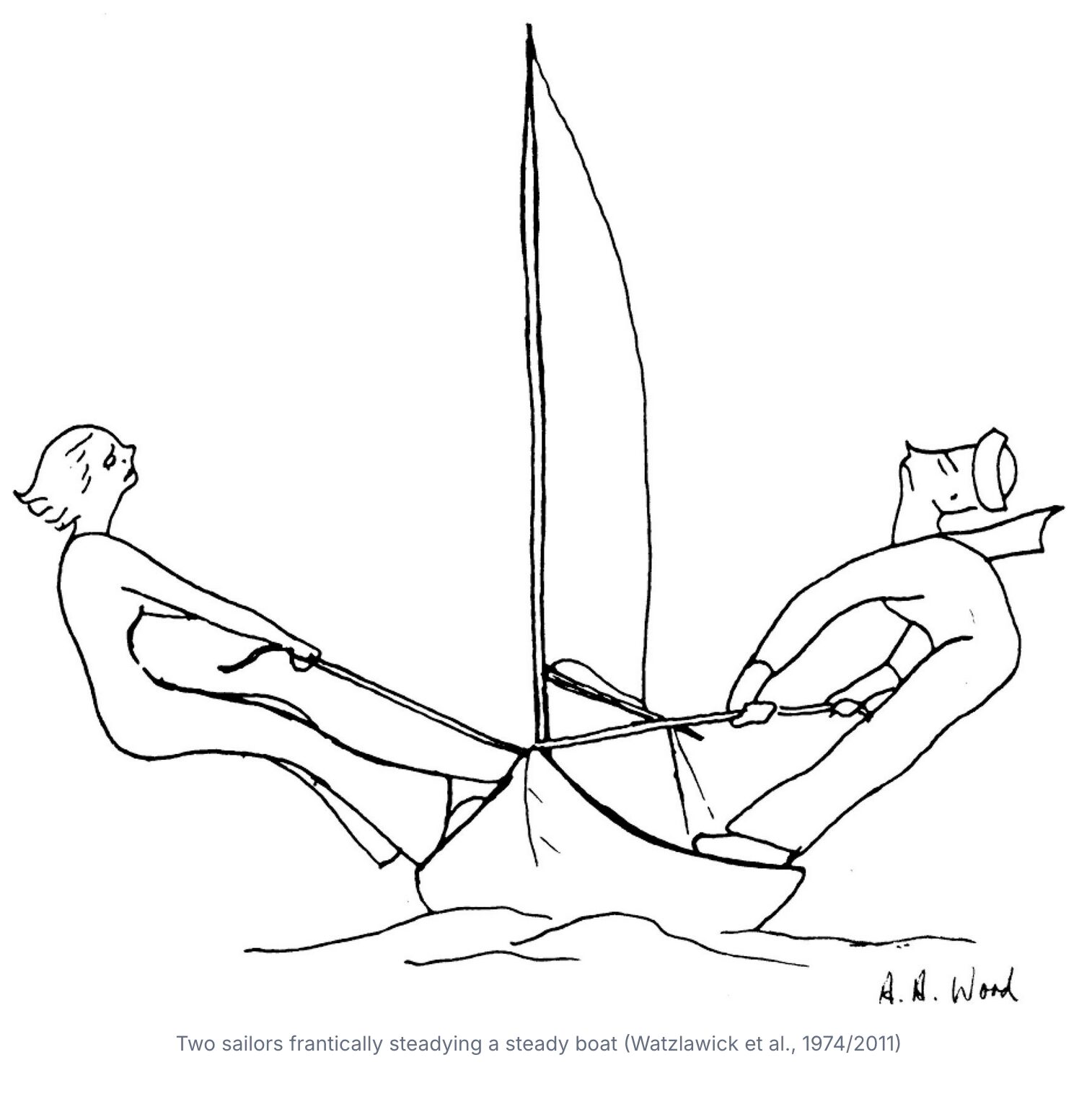
One of the earliest images in my systemic education in the early 1990s was from Watzlawick, Weakland, and Fisch’s (1974) book titled Change. In this image, two sailors are depicted as frantically trying to stabilize their boat, each leaning out and creating a temporary balance, albeit an unworkable solution for the long term. This polarization is well described in this text, with each attempt by one sailor to stabilize the boat leading to reactions in the other sailor to compensate for these changes. Simply describing the polarization that exists is not sufficient to bring about change; rather, active steps need to be taken to change the system. Watzlawick, Weakland, and Fisch suggest large system changes, including altering the rules or logic of the system, breaking patterns of interacting or relating around an issue, and reframing the problem in a way that allows those impacted to engage differently with each other. These changes allow the sailors to shift out of their extreme roles and join each other in the boat again. We know enough about trauma, pain, and suffering to realize that efforts are needed to heal painful memories and emotions so that these emotions no longer drive polarizations. In working with polarized systems, MFTs are highly skilled at reducing these polarized stances and in helping a system move to cooperation and even connection.
2. Increase meaningful dialogue
When couples are polarized and stuck, especially when these polarizations are related to perpetual or longstanding problems, Gottman (1999) suggests that these difficulties are not simply going to disappear. Couples who try to win these arguments spend considerable energy trying to convince their partner of their version of facts and attempt to get their partner to change, and they soon find out that these conversations only serve to increase the level of polarization. Gottman suggests that polarized couples (or families) are better off if they can make a shift from trying to solve the problem to engaging in dialogue about the problem. As systems therapists, we have long worked to change the process of interaction, i.e., the way in which families communicate and interact with each other. When the process changes, individuals are able to hear each other more clearly and members may end up shifting their positions, moving from polarization to connection. Moving out of this gridlock requires individuals to be willing to engage in dialogue about their problem, to soften so that they can genuinely hear each other, and to engage in conversations that are not characterized by personal attacks or put-downs. Admittedly, this is not easy to accomplish in extreme polarization. Richard Schwartz, the developer of Internal Family Systems (2020), suggests that one solution to polarizations is to approach them from a position of genuine curiosity and compassion. Listening or witnessing the full extent of another individual’s narrative through a curious or compassionate lens is invaluable in moving away from polarizations to understanding. Unfortunately, our 2026 world is driven by news cycles and social media posts. We all know that these only serve to polarize more, causing individuals to lean out further on their boats. There are few opportunities to engage in meaningful dialogue with those who differ from us. However, it is possible if we can bring people together in genuine ways to listen and to understand.
3. Work to heal trauma
Polarizations are often driven by trauma. We have all worked with cases where a couple divorces, but the pain of the divorce leads to long-term retribution by partners towards each other. These retributions involve taking partners back to court, making visitations difficult, turning children against the other parent, and similar acts. Over time, the “divorce war” has a great toll on the finances and emotional well-being of all sides involved, but the goal remains to “win” the war at all cost. It is often the pain of the end of a marriage and all that it entails that drives these efforts to get back at the ex-partner, no matter the financial or emotional tolls that result.
We all carry political pain, and it is valid to us and our experiences. I have witnessed political opponents set out to destroy the other side, not because they disagree on an issue; that is in the background. Rather, they want to see the other side lose or be crushed, and often this is driven by past hurts and perceived slights. This brings us to the question: “What needs to occur on a national and international level to heal this type of pain?” As MFTs, we need to step up. We need to continue to explore community healing approaches where processes can help individuals heal. I am reminded of the Truth and Reconciliation Commission in South Africa, which worked to heal an entire nation from past violence, oppression, and horrific abuse. In this commission, victims were able to tell their stories and hear, for the first time, that what happened to them was wrong and unjust. While the commission did not rectify wrongs or redistribute wealth, it achieved its goals of having the painful narratives of victims witnessed, and it provided a formal recognition of these events. While the pain in our current political systems may require different solutions, the Truth and Reconciliation Commission in South Africa did a great deal to bring about healing from the crimes of apartheid through an innovative and systemic process of witnessing and healing.
4. We need to go outside of the norms
In their book, Watzlawick, Weakland, and Fisch emphasize that sometimes the most obvious solutions become a part of the problem—a term they referred to as attempted solutions. The wrong solutions do not allow individuals to move on, but inadvertently keep individuals stuck and entrenched in their polarizations. As systemic thinkers, we need to be willing to think outside of the box, to go outside of obvious solutions. Our goal is depolarization at a minimum and our ideal goal is increased connection.
5. Be a voice for peace, healing, and kindness
When it comes to Family 1, we can be a voice for kindness. Our recent history has been characterized by meanness, othering, dehumanization, and attacks. We long for a kinder approach to our lives, and we can lead the way. We are experts in connection and in strong relationships. We know that strong relationships are not characterized by agreement. In fact, each day we witness how strong relationships are characterized by connection in spite of differences. How can we foster connections in a polarized culture?
I am interested in how we as Systemic Family Therapists can elevate our standing in the world and bring what we know works to our larger context. As therapists, we are effective in working with polarized couples and families. We know how to take angry, hurting, attacking individuals and, through connecting with them, reframing, validation, understanding, and other therapy processes, bring about changes in how they relate to each other, how they communicate, and how they repair when things go off track. More than ever our specialty is needed, but it requires each of us to step into the arena on a larger level.
FAMILY TWO
The second kind of family I will mention is different from the first. Family 2 is one in which a parent or other adult in the family has severely crossed boundaries and resorted to abuse of more vulnerable members of the family—sexual, physical, or emotional. Unfortunately, we have all worked with these types of family systems, and they are heartbreaking. We know that we cannot be silent in these families; we have to do everything we can to end the abuse. This would always involve contacting the police or child protective services in cases where we were mandated reporters. This kind of family represents a systemic crisis. There is no need to reduce polarizations and increase connections, at least in the short term, because the violations within the system are so bad that people are being harmed, traumatized, and scarred for life. The therapists in these situations are key protectors. They are engaging in a way that has the explicit goal of protecting victims and those who are vulnerable at all costs. This involves contacting the authorities to make sure that perpetrators are investigated and prosecuted. It involves setting up rigid boundaries between perpetrators and the rest of the therapeutic system. It involves speaking out, being an advocate, and working to change the system and the forces that allowed the abuse to occur.

When there are political acts that have occurred that have crossed a line, we need to find ways to speak out, set boundaries, protect victims, and bring about change. Sometimes this change is slow. When systems of oppression like apartheid existed in South Africa, it took years, coordinated efforts, boundaries implemented through sanctions and embargoes, and many voices speaking out. Eventually, the system of oppression crumbled. I cannot tell you how and where exactly to get involved, as those choices are personal. But I don’t believe that systemic therapists should be neutral where there is abuse, violence, crossing the line, victimization, and injustice. I encourage you to get involved in these scenarios. Speak out. Be resolute. Work with others who think the same as you do. It may take time, but together we can create just and loving systems in all of our communities. That should be our goal and our voices and our perspectives can be critical to long-term solutions.
I appreciate you reading this article. Please send me any feedback at blowa@msu.edu
Reference
Gottman, J. M. (1999). The marriage clinic: A scientifically based marital therapy. W. W. Norton & Co.
Schwartz, R. C., & Sweezy, M. (2020). Internal family systems therapy (2nd ed.). The Guilford Press.
Watzlawick P., Weakland, J. H., & Fisch, R. (1974). Change: Principles of problem formation and problem resolution. New York: Norton.