

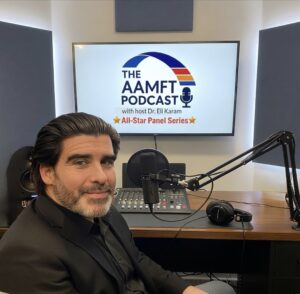
The eighth season of the AAMFT Podcast in 2026 celebrates an unprecedented gathering of systemic therapy’s most influential voices. Eight uniquely curated panels bring together 23 master therapists and model developers to talk about the heart and soul of systemic therapy. These supersized episodes offer our audience an intimate look at how diverse theoretical orientations converge around the essential elements of therapeutic change.
The All-Star Panel Series emerges at a pivotal moment in our professional evolution. As Sprenkle et al. (2009) have long argued, the field has matured beyond the “model wars” of previous decades toward recognizing that effective therapy transcends specific theoretical boundaries. This series embodies that evolution, bringing together theorists who might once have been seen as philosophical adversaries to explore their shared commitment to healing relationships and transforming lives.
The vision and purpose
The genesis of these panels reflects a deeply personal yet professionally significant undertaking for me. After seven seasons and over 135 episodes of conducting primarily individual interviews, I posed a compelling question to some of our most popular former guests: “If you could choose a colleague or two to share a panel with, who would they be?” The responses revealed something profound—therapists across diverse orientations yearned for dialogue with colleagues whose work they admired, regardless of theoretical differences. Each panel represents a carefully orchestrated conversation between complementary and sometimes contrasting voices, unified by their dedication to systemic thinking and relational healing.
Consider the first panel: Cloé Madanes, Frank Dattilio, and Norm Epstein. Here we see classic strategic therapy and cognitive-behavioral couple/family therapy sharing the same stage. What might have once seemed like an impossible gathering now represents the field’s recognition that therapeutic wisdom transcends model boundaries.
The panel of Froma Walsh, Celia Falicov, and Mary Jo Barrett exemplifies this intergenerational and cross-theoretical dialogue. Walsh’s resilience framework, Falicov’s cultural perspectives, and Barrett’s trauma-informed systemic work each emphasize different aspects of family therapy, yet their conversation reveals deep commonalities in how they conceptualize strength, adaptation, and healing within relational systems.
Perhaps most significantly, these episodes showcase “clinical wisdom”—the accumulated knowledge that comes from decades of practice, self-reflection, and refinement. When these panelists discuss their most significant therapeutic failures that changed their practice, they offer something no textbook can provide: the humility and growth that come from genuine engagement with the complexity of human relationships.
The Common Factors framework in action
The questions guiding these panel discussions deliberately invoke systemic therapy common factors that account for therapeutic success across all models (Sprenkle & Blow, 2004; Karam & Blow, 2022). Rather than focusing on technique-specific interventions, the conversations explore fundamental questions: Who is responsible for therapeutic change? How do therapists instill hope? What personal qualities contribute to therapeutic success?
This focus on common factors reflects decades of research suggesting that model-specific techniques account for only about 15% of therapeutic outcome variance, while factors common to all therapies—the therapeutic relationship, client factors, hope, expectancy, and therapist factors—account for the vast majority of change (Sprenkle & Blow, 2004). The panels bring this research to life through the lived experiences of master therapists who have spent careers refining their understanding of these universal elements.
The therapeutic alliance, consistently identified as one of the most robust predictors of outcome (Blow et al., 2007), features prominently in panel discussions. When Bill Doherty and Patricia Papernow discuss alliance building, they draw from vastly different theoretical wells—community-engaged couple therapy and stepfamily therapy respectively—yet their insights converge on the fundamental importance of creating safe, collaborative therapeutic spaces.
Similarly, the panels’ exploration of hope and client motivation transcends model-specific conceptualizations. Whether Michelle Weiner-Davis discusses solution-focused approaches to motivation, Bill O’Hanlon explores possibility therapy, or Jay Lappin draws from structural family therapy traditions, the common thread remains clear: effective therapists, regardless of orientation, understand how to mobilize client resources and instill belief in change.
Implications for the future
By making these conversations available free of charge, the series ensures maximum accessibility for students, practitioners, and educators worldwide. For training programs, these panels offer invaluable pedagogical resources. Rather than teaching models in isolation, educators can use these conversations to demonstrate how master therapists navigate the tension between theoretical commitment and clinical flexibility. As Karam and colleagues (2015) argue, effective training must help students develop both model-specific competencies and the ability to recognize and utilize common factors. These panels provide living examples of this integration.
The series also challenges us to reconsider how we conceptualize expertise in our field. The panels suggest that true mastery involves not just deep knowledge of one’s own approach but the capacity to engage meaningfully with alternative perspectives. These conversations provide a roadmap for how our field can continue evolving beyond theoretical tribalism toward what we envision as a truly integrated approach to systemic therapy—one that honors both our diverse theoretical heritage and our shared commitment to healing relationships.
The 2026 All-Star Panels remind us that at its core, family therapy has always been about connection—not just the connections we help clients forge, but the connections we create as a professional community. In bringing together these remarkable voices, the series demonstrates that our field’s greatest strength lies not in any single model or technique, but in our collective wisdom and our shared dedication to “staying systemic” and alleviating human suffering within relational contexts.

Eli A. Karam, PhD, LMFT, is an AAMFT Professional member holding the Clinical Fellow and Approved Supervisor designations, and multi-time AAMFT Award recipient. He is a Full Professor in the Couple & Family Therapy Program at the University of Louisville. He is also the host/co-executive producer of The AAMFT Podcast
Blow, A. J., Sprenkle, D. H., & Davis, S. D. (2007). Is who delivers the treatment more important than the treatment itself? The role of the therapist in common factors. Journal of Marital and Family Therapy, 33(3), 298-317.
Karam, E.A., & Blow, A. (2022). Bringing common factors to life in couple & family therapy. New York: Routledge/Taylor Francis.
Karam, E. A., Blow, A. J., Sprenkle, D. H., & Davis, S. D. (2015). Strengthening the systemic ties that bind: Integrating common factors into marriage and family therapy curricula. Journal of Marital and Family Therapy, 41(2), 136-149.
Sprenkle, D. H., & Blow, A. J. (2004). Common factors and our sacred models. Journal of Marital and Family Therapy, 30(2), 113-129.
Sprenkle, D. H., Davis, S. D., & Lebow, J. L. (2009). Common factors in couple and family therapy: The overlooked foundation for effective practice. Guilford Press.
Other articles

Perspectives
Friendship, Partnership, and Love Affair: Helping Couples Navigate the Differences so They Can Thrive Together
I see a committed relationship as having three aspects: friendship, business partnership, and love affair. Friendship is liking/respecting/enjoying a partnership, enjoying time and activities together, and, hopefully, having adventures. Business partnership is about logistics running a household (shopping, cleaning, cooking, managing money, cars, etc.), and parenting, whether that’s children and/or pets. A love affair is a deeper intimacy of sharing emotionally, physically, and sexually.
Trevor Huskey, MSSW

Perspectives
When Family Therapists Go Back Home to Their Families: Notes from an Autoethnographic Practice
Family therapists can spend a lifetime studying theories about family patterns, intergenerational communication, recursive loops, and the dance between closeness and separateness, to name a few. During our training, we are taught to map triangles, track emotional processes across decades, and listen for the stories that shape a person’s sense of personhood.
Danna Abraham, PhD

Special To This Issue
Family Therapists in Schools: Where We’ve Been and Where We’re Going
This article is a collaborative effort by members of AAMFT’s Family Therapists in Schools Topical Interest Network and school-based colleagues (contributors are listed in alphabetical order).
Anne Rambo, PhD, Jennifer Hodgson, PhD, Kathleen Laundy, PsyD, Michaelle Valbrun-Pope, MsED, Misty Schmidt, PhD, Nakisha Randolph, MA, Sandi Cox, MA