

This article is a collaborative effort by members of AAMFT’s Family Therapists in Schools Topical Interest Network and school-based colleagues (contributors are listed in alphabetical order).
Imagine that you are a high school student, depressed and anxious over conflict at home. Your parents are arguing, and their divorce seems imminent. You have checked in with your school counselors, and they are an important support, but the scope of their services does not allow for couples therapy for parents (as their code of ethics states they should provide referrals for longer-term clinical services to students or direct services to family members – www.schoolcounselor.org). You wish your parents would seek therapy on their own, but they do not, citing financial concerns and lack of time. Your attempts to talk these problems over with your parents have led to more arguing. Wouldn’t it be great if there were couple and family therapists in schools?
Perhaps surprisingly, there often are—nationwide. But this may be one of the best-kept secrets in our field. In this article, we (a group of MFT colleagues, members of AAMFT’s Family Therapists in Schools Interest Network, along with school-based colleagues who have worked closely with us) will briefly review how family therapists got into schools, how they are thriving there, the multiplicity of job openings, and a little about what it is like to work in school settings. We hope to inspire more family therapists to explore this area of practice.
Why, where, and how marriage and family therapists entered public and private schools
Why are family therapists needed in schools?
The “why” is the easiest question to answer. The need for MFTs in schools has always been evident, as children live in families and are viscerally affected by their familial context. Abundant research evidence has established the need to treat the mental health difficulties of children and teens in their family context. As the United States continues to grapple with the seemingly intractable problem of gun violence in schools, it has become increasingly clear that parental alienation and conflict between home and school are key factors in mass school shootings. School-based family therapy also allows MFTs to reach students whose parents do not have time and/or sufficient investment in the process to bring them to a mental health clinic. They may lack funds, don’t understand the benefit, or might not know their child is struggling. Family therapists in schools are also a significant benefit to teachers and administrators, and increase parent involvement overall.
But need does not always equal opportunity. It was not always immediately apparent to school administrators that MFTs were needed, given the presence of school counselors, school social workers, and school nurses. The journey to involve MFTs in school-based positions also took time, though it led to widespread acceptance. And the process has differed from state to state. Let’s start with where we are now.
 Paths to school-based employment
As the table below will show, all 50 states allow contracting between private nonprofit agencies and school districts. This has often been an avenue to bring in MFTs. The MFT technically works for the private nonprofit agency but spends all or most of their workday placed in a specific school-based site (or travels to different schools). Private practitioners may also contract in a similar fashion, especially in rural areas. Less common, but still available in most states, are jobs that are directly hired by the school district. As the reputation and value of family therapy in the schools have grown, an increasing number of states offer direct hire. An MFT hired as a direct-hire employee will have school hours and benefits and work for the school district just as a teacher or school counselor would. Finally, there are also federal opportunities. Federal funds and grants provide for the employment of Exceptional Student Education Family Counselors, who are specifically assigned to work with students with an exceptional student education diagnosis (ADHD, autism, specific learning disability, and so on) and their families. Recent federal funding cuts may imperil these positions. The Department of Defense hires (through contracts with outside agencies such as Magellan Health) Military Family Life Counselors, to work with children and families, and in areas with many military families with school-aged children, such as Hawaii, these positions may be school-based.
Titles we have encountered often include Family Counselor, Trust Counselor, Behavioral Health Specialist, and School-Based Mental Health Clinician. Titles may be even more regionally specific.
Why aren’t these openings more widely known?
Often, when we have presented this information in presentations by AAMFT’s Family Therapists in Schools Interest Network, we have been challenged by audience members who stated they were unaware of these openings in their states. The confusion comes from the terminology. This information comes from rigorous research into posted job openings and conversations with MFTs already working in the schools. Job postings frequently include words like “urgently needed” and may offer hiring bonuses, especially in rural areas. So the opportunities are there. However, many—indeed, most—school districts prefer to avoid the term “family therapy.” Referring a student to a “family therapist” may trigger parental avoidance or anger and raise issues about school involvement in private matters. Accordingly, these positions are often given an alternative title. Titles we have encountered often include Family Counselor, Trust Counselor, Behavioral Health Specialist, and School-Based Mental Health Clinician. Titles may be even more regionally specific. In Indiana and Iowa, one sees posted positions for Student Success Coach. In Massachusetts, perhaps due to an influence from narrative therapy, the position title is Restorative Practices School-Based Counselor. In Texas, Intervention Counselor, Crisis Counselor, Mental Health Counselor, Mental Health Manager and Student Support Counselor have all been noted. If searching for a direct hire school-based position, search for an LMFT-eligible position, rather than focusing on the specific wording. Military Family Life Counselor positions are posted on the relevant contractors’ sites, and ESE Family Counselors as well as the other direct hire positions are posted on the individual school district site. Agencies that contract with school districts post on their own websites for school-based positions. Thus, it is often a bit of a hunt. However, the number of positions is growing.
The table below refers to public school districts. Private and parochial schools follow their own guidelines and may be even more flexible. They are best approached individually.
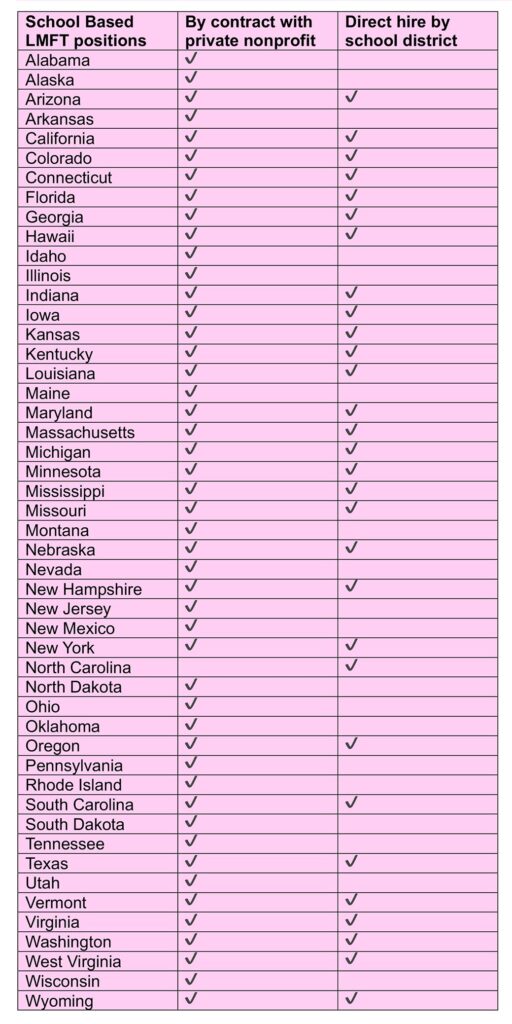
What’s the history behind this growing acceptance?
As previously noted, different states have followed different trajectories in increasing their welcome for family therapists in schools. Connecticut was one of the first to make significant changes and is still a leader in this area. Kathleen Laundy and her colleagues advocated for a legal change that made it possible for school administrators to hire MFTs. Students from a COAMFTE-accredited program, Central Connecticut State University, had worked in school settings as part of their internship. Laundy and Dr. Ralph Cohen, director of the CCSU Counseling and Family Therapy Department, led the six-year effort to change Connecticut state law to allow MFT graduates to be hired after graduation directly by school districts. Laundy brought her background in MFT, social work, psychology, and special education to her certification efforts. She applied her systemic training to work with teachers, MFT students, and administrators to understand the value of systemically trained therapists in schools. In 2007, Connecticut passed the first school certification law for MFTs in the country. Included in that effort were several leaders (principals, administrators, and teachers) who had benefitted from having MFT interns in their school systems, as well as MFT graduates who had done school-based internships.

In Florida, the path was more informal and relationship-centered. In 2004, Fanya Jabouin, a recent MS graduate from the COAMFTE-accredited MFT program at Nova Southeastern University (NSU), began volunteering at a local elementary school. The school’s primary population (Haitian-American) was a fit with Jabouin’s cultural and linguistic competencies, and she felt supported by the principal, Michaelle Valbrun-Pope, who represented this community as well. Jabouin was able to expand collaboration within the larger community to enhance the school-home connection and student academic achievements. Jabouin worked with the then MS program director at Nova Southeastern University (NSU), Anne Rambo, to bring out additional MS students to help her in this work. Valbrun-Pope was pleased with this collaboration and found a way to hire Jabouin as a family counselor after her graduation. Valbrun-Pope, together with colleagues such as Dr. Laurel Thompson, director of student services, worked to obtain funds to hire other MFTs in the Broward County system, in direct school-based positions. NSU MFT students also continued to gain experience school district-wide in school-based internships. This was greatly facilitated by Valbrun-Pope as she rose within the district to eventually retire with the title of Chief, Student Support Initiatives & Recovery. The NSU program allowed relational hours for clinical work with public school students placed in a special intensive program together for at least six hours a day. Students also had many opportunities to work with parents and families as well (not to mention the couples therapy that can happen with high school couples!) MFT students worked at the elementary and middle school level, and with a nationally recognized alternatives to external suspension program at the high school level. Benefits to students included experience before graduation, opportunities to work in schools after graduation, and publication and presentation opportunities on these collaborative efforts, including several dissertations, numerous articles and book chapters, and presentations at international conferences.
After the 2018 Parkland school shooting (which took place in Broward County), Laundy, who had retired to Florida, helped Parkland shooting survivors lobby for increased family counseling. Valbrun-Pope set up district-wide wellness centers to provide mental health services. Broward County was already a model for the state in its provision of mental health services, and after the tragedy, other counties also increased efforts, including the provision of mobile mental health teams in Miami-Dade and Palm Beach counties. Funding was allocated at the state level, and there are now family counselors in Florida schools statewide, under various titles.
 More recently, in Oregon, Sandi Cox has been involved in efforts to establish a school Medicaid billing system in her district after the state passed a ruling this year allowing LMFTs and LPCs to bill for their services within the school setting. Schools will now be able to sustain these services through ongoing reimbursement. This also provides opportunities to develop partnerships with private practitioners and/or community-based agencies to increase services provided in the school setting.
Within the past two years, Jennifer Hodgson and colleagues Chad Jordan and Angela Lamson in North Carolina led efforts to include MFTs in the 2025 State Plan Amendment (SPA). This change allowed the North Carolina Department of Health and Human Services to expand the list of reimbursable providers under the school Medicaid program to include MFTs. This crucial amendment helped to enhance the availability of critical family-centered therapy for students, improve outcomes, and help fill gaps in services for vulnerable children and their families. As in Connecticut and Florida, Hodgson and Lamson’s MFT students initially showed the value of MFTs in schools to unfamiliar administrators.
As noted above, MFT students from COAMFTE-accredited programs help demonstrate the value of MFTs in schools. In turn, school districts look to hire graduates who have this direct experience in school settings. Although many accredited programs offer internships in school settings, such placements are not currently required; greater encouragement to develop additional school-based internship sites would, in our opinion, strengthen the field, as school-based experience greatly helps graduates to obtain school-based jobs. The collaboration between NSU and Broward County, Florida, schools lapsed after Rambo retired; school district and university relationships are at times dependent on one or more faculty members who are passionate about the collaboration, and thus these partnerships can be vulnerable to administrative changes.
What’s the experience of school-based family therapy?
For the MFT, school-based work allows for an increased level of systemic integration. Rambo remembers a teen in foster care, recovering from a history of trauma, who was searching for a way to see herself as someone worthy of respect. The client identified the school nurse as someone in her life who had treated her with respect and who was regarded by others with admiration. Because it was school-based therapy, not only could this shining exception be discussed, Rambo was then able to enlist the school nurse as a mentor and work with the guidance counselor to help the student enroll in a health professions preparatory program. Thus, an entire system could help the teen with her goal.
Nakisha Randolph, who worked in a rural area where youth violence and crime were prevalent, found that she had to move outside of the comfort zone of the therapy office to be able to make a more significant difference. She found her work was most successful when she was collaborative with community entities. She also attended community meetings and became involved in the wider system both within and around area schools. Randolph was responsible for helping to coordinate her school district’s first Gang Symposium, which led to an aggressive campaign by the Sheriff’s Office to work within the schools to educate and eliminate gangs. School-based work builds on the AAMFT DEI guidelines in a very direct and applicable way.
Family therapists are often asked to hold complexity quietly, supporting students and families while navigating shifting legal and institutional boundaries.
School-based work also places the MFT on the front lines of social change, for good and for ill. Misty Schmidt, who has provided school-based work in Texas, has seen the effect of chilling laws making it more difficult to discuss gender identity, sexual orientation, and even possible suicidality. These policies have altered not only what can be documented, but how students experience safety, trust, and visibility within school systems. In such environments, family therapists are often asked to hold complexity quietly, supporting students and families while navigating shifting legal and institutional boundaries.
Difficult as this can be, it would be so much more difficult for the children involved without systemically minded therapists advocating for them. Family therapists in schools are uniquely trained to recognize how student distress can be shaped by relational, cultural, and policy-level forces. In school settings, family therapists help educators, administrators, and families understand that student behavior does not occur in isolation, but emerges at the intersection of home life, school life, community stressors, and sociopolitical context.
School-based family therapists frequently serve as liaisons between these systems, supporting students directly while also consulting with teachers, administrators, parents and caregivers. Even when direct conversations are limited, family therapists in schools can advocate for relational safety, inclusive practices, and trauma-informed responses that protect vulnerable students without placing schools at legal risk.
In this way, school-based family therapy exemplifies the profession’s long-standing commitment to social responsibility. MFTs in schools are not only providing mental health services; they are participating in prevention, shaping school culture, and helping schools remain humane during times of social tension. This work is not always visible, but its impact is profound, often determining whether students feel seen, supported, and connected enough to remain engaged in learning and in life.
Next steps
School-based family therapy is a fast-growing area of employment for MFTs, and one that places the profession at a critical intersection of education, mental health, and public policy. It offers unmatched opportunities to directly influence the future of our country and the lives of children, not only through individual intervention but through systemic advocacy and collaboration. For many, involvement begins in their internship in a COAMFTE-accredited program. We hope COAMFTE will continue to support such internships and that AAMFT will continue to help advocates in every state push this issue forward.
Interested in learning more or connecting with us?
Please consider joining AAMFT’s Family Therapists in Schools Interest Network; we also offer free group support and job listings.

Anne Rambo, PhD, LMFT, Professor Emeritus Nova Southeastern University,
Past chair, AAMFT Family Therapists in Schools Interest Network

Jennifer Hodgson, PhD, LMFT, Professor Emeritus, East Carolina University
Principal Consultant Health Management Associates

Kathleen Laundy, PsyD, LMFT, Past Faculty, Central Connecticut State University
First chair, AAMFT Family Therapists in Schools Interest Network

Michaelle Valbrun-Pope, MsED, Executive Director/CEO,
Center for Family and Community Restoration

Misty Schmidt, PhD, LMFT-S, Behavioral Health Supervisor,
St. Mary’s Family Medicine Residency, Current chair, AAMFT Family Therapists in Schools Interest Network

Nakisha Randolph, LMFT, University of South Carolina, Counseling Education and Supervision Doctoral Program
Research Chair, AAMFT Family Therapists in Schools Interest Network

Sandi Cox, LMFT, Mental Health Coordinator, Lebanon Community School District
AAMFT Family Therapists in Schools Board Member
Other articles

Perspectives
When Family Therapists Go Back Home to Their Families: Notes from an Autoethnographic Practice
Family therapists can spend a lifetime studying theories about family patterns, intergenerational communication, recursive loops, and the dance between closeness and separateness, to name a few. During our training, we are taught to map triangles, track emotional processes across decades, and listen for the stories that shape a person’s sense of personhood.
Danna Abraham, PhD

Perspectives
Friendship, Partnership, and Love Affair: Helping Couples Navigate the Differences so They Can Thrive Together
I see a committed relationship as having three aspects: friendship, business partnership, and love affair. Friendship is liking/respecting/enjoying a partnership, enjoying time and activities together, and, hopefully, having adventures. Business partnership is about logistics running a household (shopping, cleaning, cooking, managing money, cars, etc.), and parenting, whether that’s children and/or pets. A love affair is a deeper intimacy of sharing emotionally, physically, and sexually.
Trevor Huskey, MSSW
A Message From The President
The Role of MFTs in Uncertain Political Times: Two Families as an Example
No matter what side of the political spectrum you find yourself, I think all will agree that the past year has been a roller coaster ride in United States (US) politics. Politics have ranged from usual polarizations, arguments, and stuck positions, to abuse, killings, overt racism, and heightened policing, to name a few.
Adrian Blow, PhD