

Recently, there has been a notable shift in public attention toward women’s health. Conditions that were once not en vogue (e.g., perimenopause, hormonal health, reproductive pain, etc.) have begun moving into mainstream visibility. Dialogue about women’s health is carried by social media, celebrity disclosures, and a growing cultural willingness to name what was previously left in the margins of personal experience (Orgad & Rottenberg, 2024). Although this attention is not without value, consumer markets are quick to commodify women’s suffering, promoting supplement lines, wellness retreats, and self-care strategies that promise relief, transformation, and empowerment. Yet conditions such as endometriosis remain too complex, too often dismissed, and too culturally ignored to be fully understood by those who live outside the experience.
Endometriosis is a debilitating, chronic condition affecting approximately one in ten women globally (World Health Organization, 2023). Consider, for example, diabetes, which affects one in nine adults worldwide (International Diabetes Federation, 2025), and received over one billion dollars in NIH research funding in 2022. Endometriosis, with comparable prevalence, received sixteen million dollars (Ellis et al., 2022). This research funding gap highlights a story of structural and systemic inequalities that have consistently deprioritized women’s bodies as a site of care and serious inquiry. Unsurprisingly, women living with endometriosis wait an average of six to ten years before receiving a diagnosis (Nnoaham et al., 2011; Fryer et al., 2025), a delay that has remained largely unchanged for decades.

It is fair to say the majority of women with an endometriosis diagnosis navigate life transitions, workplace conditions, and medical events in a kind of cultural silence. A question worth asking: reader, how many of the women you know in clinical spaces, families, workplaces, and friendships are doing the same? Quietly organizing their lives around pain that has yet to be acknowledged.
Normalized pain, normalized medical practices
To understand why women’s pain is so easily dismissed, revisiting the history in which standards of care were developed can help contextualize this suffering. Modern gynecology in the United States was built, in significant part, on the bodies of enslaved Black women, who were subjected to operations without meaningful consent and often without anesthesia (Hodge, 2025). Among the most well-known examples is J. Marion Sims, often referred to as the “father of modern gynecology,” who established many of the field’s early surgical techniques that became foundational knowledge in medicine (Ojanuga, 1993). The knowledge about these dehumanizing experiments was recovered and documented by sociologist Deirdre Cooper Owens, who traced how enslaved women’s suffering became the foundation on which a medical specialty was built, even as those same women were denied the status of patients who were deserving of care (Cooper Owens, 2017; refer to figure 1).
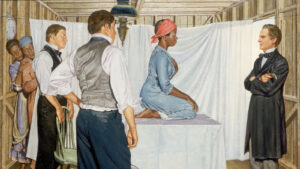
Figure 1. Illustration from The New York Times book review “Say Anarcha,” by J.C Hallman, 2023. Anarcha’s story has become emblematic of the historical normalization of women’s pain and the exploitation of enslaved Black women’s bodies for the advancement of medical knowledge.
Women’s health continues to reflect enduring clinical assumptions that normalize women’s pain, even as researchers increasingly advocate for the importance of evidence-based pain management and patient-centered care (Bayer et al., 2025). Although contemporary gynecologic practice is fundamentally different from its historical origins, the expectation that women should tolerate procedural pain reveals a troubling continuity. Routine procedures are still frequently performed without adequate analgesia despite evidence that many patients experience severe pain. Nearly half of patients undergoing IUD placement, for example, report intense pain, yet most are not offered pain-management options, reflecting an enduring tendency to minimize women’s pain rather than proactively treat it (Bayer et al., 2025).
Public attention to the pain associated with routine gynecologic procedures intensified after thousands of women shared their experiences of IUD insertion and other procedures across social media (e.g., TikTok, Instagram, etc.), challenging longstanding assumptions that these interventions caused only minimal discomfort. As these women shared their stories, the Centers for Disease Control and Prevention (CDC) revised its U.S. Selected Practice Recommendations for Contraceptive Use on August 8, 2024 (Curtis et al., 2024).
For the first time in years, the guidelines recommend that clinicians counsel all patients about the potential for pain during IUD placement and other procedures, discuss the risks and benefits of available pain-management options, and develop a person-centered pain-management plan based on patient preferences (Curtis et al., 2024). These recommendations mark a notable departure from the 2016 guidelines, which did not recommend routine counseling about procedural pain or shared decision-making regarding pain-management options (Curtis et al., 2016, 2024). Yet evidence alone has not translated into widespread practice.

The importance of Relational Care for Women’s Health
The normalization of women’s pain is not unique to medicine. Helping professions, including marriage and family therapy (MFT), have also largely overlooked the female body within conceptualizations of relational care. Consider, for a moment, the experiences that are at the center of therapeutic work. Training in MFT emphasizes communication patterns, emotional injuries, attachment, behavioral interactions, and family intergenerational processes—essential areas of relational competence forming the foundation of MFT curricula across the United States (COAMFTE, 2021; Northey & Gehart, 2020). Yet the female body as a site of pain, cyclical change, medical intervention, and relational consequence continues to receive remarkably little attention.
The embodied realities of menstruation, endometriosis, fertility treatments, pregnancy loss, menopause, hysterectomy, and other gynecological experiences remain underrepresented from systemic conversations about relational health and therapeutic care.
Although somatic approaches have gained prominence in recent years, inviting therapists to understand the body as a repository of memory, trauma, and healing (Porges, 2011; van der Kolk, 2014), the embodied realities of menstruation, endometriosis, fertility treatments, pregnancy loss, menopause, hysterectomy, and other gynecological experiences remain underrepresented from systemic conversations about relational health and therapeutic care (Gagliardi et al., 2019).
The relational and social consequences of women living with endometriosis extend far beyond individual pain. Challenges persist in obtaining a diagnosis, painful periods, missed workdays, and the uncertainty of relationship challenges, and the emotional labor of navigating healthcare and social systems that frequently offer little accommodation and even less understanding. Yet these experiences can remain invisible within therapeutic conversations, even though they influence couple dynamics, parenting, sexual intimacy, employment, and the emotional distribution of care within and across families.

If relational care is to respond to the realities of women’s health, relational practitioners must begin by making visible what has long remained at the margins of therapeutic conversations. The practices that follow are just a few invitations that could offer greater acknowledgment of women’s embodied experiences and more opportunities for relational care.
 Resist the normalization of women’s pain
A relational stance begins by treating pain as meaningful rather than expected. Therapists can invite conversations about how pain has been interpreted by healthcare providers, family members, partners, and the women themselves, while resisting the cultural expectation that gynecological symptoms are something to endure. Rather than asking, “How do you cope with the pain?” therapists might first consider: “Who has helped you make sense of your pain, and who has dismissed it?” Such questions shift the focus from symptom management to the relational stories that have shaped women’s experiences of being believed or normalized.
 Invite conversations about the relational journey of healthcare
Medical care is itself a relational experience. Diagnostic delays, repeated pelvic examinations, surgeries, and encounters with healthcare professionals often leave lasting relational consequences that extend beyond a single event. Relational practitioners can develop opportunities to witness how clients experience medical examinations, interactions with physicians, the diagnostic process, and the responses of partners, family members, employers, and friends. These conversations can help externalize experiences of medical challenges that belong to the social world instead of being part of individual domains. In doing so, therapy acknowledges healthcare encounters as part of the client’s relational story rather than as isolated medical events.
 Help women socialize their pain
Relational care can also support women by helping them socialize their pain. Moving it from a private experience where women are expected to manage alone to a shared relational experience that can be witnessed, understood, and responded to collectively. Therapists can invite partners, family members, and significant others into conversations that develop a shared language around chronic illness and its relational effects. At the same time, women can be supported in developing initiatives to create relational spaces where pain is no longer hidden or explained away. Creating circles of care, gathering with others who share similar experiences, or simply resisting the familiar response of “I’m fine” when asked “How are you?” are small but meaningful ways of interrupting the social performance that pain should remain invisible.
Perhaps women’s health has been absent from our imagination in terms of what relational care could become. If relational practitioners are committed to understanding lives in context, then the reality of women’s chronic pelvic conditions should not live outside therapeutic conversations. The body has never been separated from relationships, and the invitation, then, is a simple one: to ask different questions that can offer a window into experiences that remain invisible and use this material to creatively reorganize what has been normalized—to break out of convention by saying or doing what could not have been previously imagined.
Resources
End of the Cycle. A feature-length documentary that highlights the lived realities of women with endometriosis. It is an excellent resource for women, partners, families, and healthcare professionals. https://linktr.ee/endocollective
Endowhat? A documentary film combining patient narratives with interviews from internationally recognized specialists to dispel myths about endometriosis, explain evidence-based care, and advocate for earlier diagnosis. It is widely used by patients, educators, and advocacy organizations. https://www.endowhat.com/
ProjectEndo An educational initiative that uses films, healthcare provider education, and policy advocacy to improve diagnosis, awareness, and treatment of endometriosis. https://www.projectendo.org/ourstory

Danna Abraham, PhD, LMFT, works as an educator at the California School of Professional Psychology at Alliant University. She is an AAMFT Professional member holding the Approved Supervisor and Clinical Fellow designations. Her work focuses on community-based research and feminist approaches to critical engagement, with a particular focus on language and lived experiences. She is the director of the Research Initiative for Storytelling Engagement (RISE) Lab. www.theriselab.com / dr.danna.abraham@icloud.com
Bayer, L., Ahuja, S., Allen, R. H., Gold, M. A., Levine, J. P., Ngo, L. L., & Mody, S. (2025). Best practices for reducing pain associated with intrauterine device placement. American Journal of Obstetrics and Gynecology, 232(5), 409–421. doi:10.1016/j.ajog.2025.01.039
Commission on Accreditation for Marriage and Family Therapy Education. (2021). Accreditation standards, version 12.5. Retrieved Aug 8, 2026https://coamfte.org/Common/Uploaded%20files/COAMFTE/Accreditation%20Resources/2018%20COAMFTE%20Accreditation%20Standards%20Version%2012%20May.pdf
Cooper Owens, D. (2017). Medical bondage: Race, gender, and the origins of American gynecology. University of Georgia Press.
Curtis, K. M., Jatlaoui, T. C., Tepper, N. K., Zapata, L. B., Horton, L. G., Jamieson, D. J., & Whiteman, M. K. (2016). U.S. selected practice recommendations for contraceptive use, 2016. MMWR Recommendations and Reports, 65(4), 1–66. https://doi.org/10.15585/mmwr.rr6504a1
Curtis, K. M., Nguyen, A. T., Tepper, N. K., Zapata, L. B., Snyder, E. M., Hatfield-Timajchy, K., Kortsmit, K., Cohen, M. A., & Whiteman, M. K. (2024). U.S. selected practice recommendations for contraceptive use, 2024. MMWR Recommendations and Reports, 73(3), 1–77. https://doi.org/10.15585/mmwr.rr7303a1
Ellis, K., Munro, D., & Clarke, J. (2022). Endometriosis is undervalued: A call to action. Frontiers in Global Women’s Health, 3, Article 902371. https://doi.org/10.3389/fgwh.2022.902371
Fryer, J., Mason-Jones, A. J., & Woodward, A. (2025). Understanding diagnostic delay for endometriosis: A scoping review using the social-ecological framework. Health Care for Women International, 46(3), 335–351. https://doi.org/10.1080/07399332.2024.2413056
Gagliardi, A. R., Dunn, S., Foster, A., Grace, S. L., Green, C. R., Khanlou, N., Miller, F. A., Stewart, D. E., Vigod, S., & Wright, F. C. (2019). How is patient-centred care addressed in women’s health? A theoretical rapid review.BMJ Open, 9(2), e026121. https://doi.org/10.1136/bmjopen-2018-026121
Hodge D. A. (2025). The (intractable) medical ethics of Dr. J. Marion Sims: The historical record set against his ethics.Journal of healthcare, science and the humanities,15(1), 90–104. PMCID:PMC13101421
International Diabetes Federation. (2025). IDF Diabetes Atlas (11th ed.). International Diabetes Federation. https://diabetesatlas.org/
Northey, W. F., Jr., Gehart, D. R.(2020).The Condensed MFT Core Competencies: A Streamlined Approach for Measuring Student and Supervisee Learning Using the MFT Core Competencies. Journal of Marital and Family Therapy,46,42–61.https://doi.org/10.1111/jmft.12386
Nnoaham, K. E., Hummelshoj, L., Webster, P., D’Hooghe, T., de Cicco Nardone, F., de Cicco Nardone, C., Jenkinson, C., Kennedy, S. H., Zondervan, K. T., & World Endometriosis Research
Foundation Global Study of Women’s Health Consortium. (2011). Impact of endometriosis on quality of life and work productivity: A multicenter study across ten countries. Fertility and Sterility, 96(2), 366–373. https://doi.org/10.1016/j.fertnstert.2011.05.090
Ojanuga, D. (1993). The medical ethics of the “father of gynaecology,” Dr J Marion Sims. Journal of Medical Ethics, 19(1), 28–31. https://doi.org/10.1136/jme.19.1.28
Orgad, S., & Rottenberg, C. (2024). Mediating menopause: Feminism, neoliberalism, and biomedicalisation. Feminist Theory, 25(3), 338-358. https://doi.org/10.1177/1464700123118
Porges, S. W. (2011). The polyvagal theory: Neurophysiological foundations of emotions, attachment, communication, and self-regulation. W. W. Norton.
Robstad, N., Paulsen, A., Vistad, I., Hott, A. C., Berg, K. H., Øgård-Repål, A., Rabben, J., Kristoffersen, E. W., & Rohde, G. (2025). Experiences of pain communication in endometriosis: A meta-synthesis. Acta Obstetricia et Gynecologica Scandinavica, 104(1), 39–54. https://doi.org/10.1111/aogs.14995
van der Kolk, B. (2014). The body keeps the score: Brain, mind, and body in the healing of trauma. Viking.
World Health Organization. (2023, March 24). Endometriosis. https://www.who.int/news-room/fact-sheets/detail/endometriosis
Other articles

When Safety Isn’t Enough: What Sexual Disconnection Reveals About Nervous System Sequencing in Couples
Many MFTs have had this experience: a couple completes a significant phase of therapy feeling more emotionally connected than they have in years. However, their sexual relationship remains flat, contracted, or absent. Sensate focus exercises are assigned, or a sex therapy referral is made. Progress stalls. The question worth asking is not what is wrong with the couple, but what is missing from the sequencing. Couples can become emotionally safer without becoming erotically available to one another. That gap is the clinical problem this article addresses.
Skylar Collé, PhD

For the Joy of Working with Children
I have heard through the grapevine that many MFTs are hesitant to work with kids. That’s understandable. In my training, there was little in the way of a developmental psychology focus. When my internship supervisor at Jewish Family Services in Stamford, Connecticut, handed me a file about Sandplay, because I was working with youngsters whose parents were divorcing, I felt excited and unsure. What was I to do as a six-year-old dug deep into a sandbox to unearth her devastation about being dragged between warring households? Just sit there?
Neal H. Brodsky, MA

The Third Actor in the Room: How AI Is Quietly Changing Therapy
Robert scheduled an individual session to process the latest fight he had with his wife. As one member of a couple I had been seeing for two years, I was well aware of Robert’s pattern and had honed in on a diagnosis of bipolar disorder, preparing to initiate a discussion about this with Robert. Imagine my surprise when he summarized the interaction with his wife and, without missing a beat, ended the monologue with “I know I don’t have bipolar disorder. I asked Chat GPT and it told me I didn’t.”
Katherine M. Hertlein, PhD