

A graduate student begins a session with a couple. One partner does most of the talking. The other gives short, brief answers. Inside of two minutes, the talkative partner keeps pressing the student to take their side, and the student has to decide, right then, whether to follow their lead or turn toward the quieter partner. None of this is happening in a clinic. The couple are AI-driven avatar clients on a computer screen, and the student is practicing from a laptop at home. No real relationship is at stake. The skill practice, though, is real, and so is the feedback waiting at the end.
That kind of low-stakes rehearsal barely existed until recently, and it targets the gap at the center of clinical training: the distance between knowing about therapy and being able to do it. We teach in marriage and family therapy (MFT) graduate programs, and every year we see that students can describe Bowenian theory in depth for an exam. They can map a genogram and name a structural boundary. Then they walk into their first practicum session, a real family starts talking over one another, and the carefully, yet theoretically, learned concepts evaporate. For marriage and family therapists (MFTs), that gap is widest precisely where our work is most demanding and distinctive, in the room with more than one client.

Decades of common-factors research point to a few therapist behaviors that consistently move outcomes, chief among them the ability to form and repair a strong alliance and to respond with accurate empathy across a wide range of clients (Wampold, 2015). Both get harder when a second or third person enters the room. We are not building and sustaining one alliance. We are developing several at once, along with identifying the alliances family members hold with each other. That complexity is our professional signature, and it is also one of the skills our students may often feel least comfortable applying (Georgiadou et al., 2025).
 Most of what separates a skilled systemic therapist from a knowledgeable one cannot be lectured into place. Lecturing and paper- or discussion-based assignments develop declarative knowledge. Declarative knowledge is what a student can recall and explain, and it tends to come quickly from reading and lecture. On the other hand, procedural knowledge is what a person can perform under stress, and it is largely implicit, built through repetition rather than recall (Koziol & Budding, 2012). The bridge between the two is deliberate practice (DP), an approach Ericsson (2003) described through his studies of expert performers. Skill improves when a learner works toward a well-defined goal, receives specific feedback, and repeats the attempt many times (Ericsson, 2003). Competence does not arrive in one strong performance. It emerges through repetition with variation; the same skill rehearsed across many slightly different situations.
Deliberate practice is no longer just a method borrowed from sports and music; the evidence has moved squarely into our own field. Blow et al. translated it specifically for systemic family therapy, turning the approach into skills tailored to MFTs (Blow et al., 2023). Researchers have begun testing DP across psychotherapy training more broadly (Clements-Hickman & Harris, 2024). Before them, Yamin et al. had reported the same pattern for emotional-processing skills, where experiential practice beat didactic instruction (Yamin et al., 2023). Ogles et al. also found that beginning therapists who practiced ethical responses through DP outperformed peers who only discussed the same situations (Ogles et al., 2025).
None of this makes peer role-play less worthwhile; it simply means the volume of focused, feedback-rich repetition that deliberate practice calls for is hard to reach this way.
Deliberate practice is demanding to deliver. It needs many repetitions, each followed by specific feedback, and that can be hard to provide at scale through traditional MFT training alone. For decades, the most common rehearsal tool has been peer role-play, and it remains a valuable one. A classmate plays the client, the student practices, the class debriefs, and a thoughtful peer can offer useful feedback against the skill criteria. Even at its best, though, the format has constraints. Class time is limited, so each student tends to get only a few attempts. A classmate, even a skilled one, may not consistently sustain a withdrawn teenager or a stonewalling partner, and the realism can vary from one role-play to the next. Additionally, an instructor is not always able to give each student individualized feedback in the moment. None of this makes peer role-play less worthwhile; it simply means the volume of focused, feedback-rich repetition that deliberate practice calls for is hard to reach this way.
This is where AI-powered avatar simulation may help, as it offers at scale the kind of repeated, feedback-rich practice that peer role-plays struggle to provide. One of us chairs the MFT program at The Chicago School, where students now practice on a platform called SimCare (simcare.ai). It lets them hold spoken therapy sessions with avatar clients across individual, couple, and family scenarios, more than 500 in all, on their own schedule. After each session the platform produces a transcript and rubric-based feedback that the student and faculty member both see, measured against criteria the program’s faculty designed for each course. A student can run the same difficult opening several times, get specific notes each time, and build from beginner to advanced.
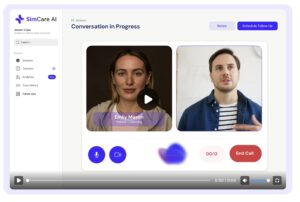
Our field has met avatar clients before. AAMFT introduced a mixed reality simulation program in which trained improvisation actors voiced and animated the avatars in real time. The idea was sound, but a live person had to power every session. The difference now is that generative AI drives the client itself. No one sits behind the screen, which is why a student can run a session at any time and a program can offer the practice at scale.
The family and couple scenarios matter most to us, and this is where the fit with our profession becomes clear (Georgiadou et al., 2026). In a family simulation, each avatar responds through generative AI not only to the student but to what the other family members say. A teenager reacts after a parent criticizes them. One partner escalates as the other defends. The student has to join with several people at once, notice who holds power in the conversation, and decide whether to track the content or shift the process. That is systemic work. It is the skill set hardest to practice in a classroom, and it is the one our trainees most need before they sit with a real family client.
The evidence for simulated clients is not confined to our discipline. In a randomized controlled trial in medical education, students who practiced with large language model patients and received structured feedback improved their clinical decision making more than a control group (Brügge et al., 2024). A second medical study found that learners who trained with an AI-simulated patient strengthened specific interviewing behaviors and described the encounters as realistic enough to carry into real practice (Yamamoto et al., 2024). Closer to our own training context, a meta-analysis in social work education found virtual clients at least as effective as live standardized clients, with the strongest benefits coming from short, repeated, focused practice (Zhang & Stepteau-Watson, 2024). The mechanism is the one Ericsson (2003) described: repetition, feedback, variation.
What students say points back to where we began: the distance between knowing and doing.
That is what we set out to build. At The Chicago School, the program maps simulation sessions to specific models, including Bowenian, structural, and strategic. The rubrics center on observable behaviors such as joining, enactments, and boundary-setting, so a student’s feedback ties back to a specific systemic skill instead of a general counseling one. We have also worked with the platform’s developers to test and recalibrate the avatar clients, so the personas behave more like the families we see in practice. What began as a small summer pilot there has now reached nearly 300 students across seven courses. What students say points back to where we began: the distance between knowing and doing. In course evaluations and written reflections, they describe practicing in a low-stakes space as a way to build confidence before real client contact, and many note that running sessions made classroom theory feel more concrete and applicable.
 None of this replaces supervision or contact with real human clients. This training carries real risks, including students overestimating their own skill development and overrelying on the anticipated reactions of AI avatar clients. We therefore pair every block of practice with reflective logs and live discussions. Bias is another serious concern, because these models carry specific behavioral patterns in their training data. For example, GPT-4 has generated clinical vignettes that stereotyped patients by race and gender (Zack et al., 2024). Speech recognition compounds the problem. One study found that automatic transcription performed worse on Black patients’ speech than on White patients’, which can misrepresent a student’s actual work (Zolnoori et al., 2024). We ask students to watch for all of this and report it. Faculty also review and pre-approve every client scenario before it reaches a course. An avatar can present with a unique cultural background, but it cannot substitute the depth of a real cross-cultural relationship. We believe that acknowledging that limit is itself a piece of systemic, ethically grounded training.
Simulation can generate endless repetitions, but it cannot supply judgment. A marriage and family therapist is the one who reads what those repetitions mean, catches where the feedback misleads, and weighs how a relational and cultural frame should reshape it. The profession is now beginning to define that judgment formally. Hertlein and Springer (2026) recently published the first set of AI competencies for couple and family therapy, six domains grounded in relational ethics and systemic thinking. They treated AI as a new entity in the therapeutic system, not a neutral tool. They argued that MFTs are the discipline best positioned to govern that role. Avatar simulation is one place students can begin building those competencies under supervision, before the stakes with human clients become real. The questions we ask of it may also be systemic ones: Whose voice is missing? What is the pattern between these people, not just inside one of them? Students who learn to interrogate a simulation that way are rehearsing the thinking that makes an MFT an MFT.
We are early in this work, and we are clear about its limits. Avatar simulation will not replace live supervision or real clinical experience, and it will not teach a student to sit with a grieving family. What it can do is give that student many quiet rehearsals before the first real session, so that when a real couple turns tense and one partner goes silent, the student has met that moment before and can respond and repair. For a profession built on what happens between people, that head start is worth taking seriously.
Author’s note: The authors adapted this article from their own conference presentations on this topic. They used a generative AI assistant to help draft and edit the manuscript, and they reviewed, verified, and approved all content, citations, and clinical claims. The authors take full responsibility for the final article

Jay Burke, PsyD, LMFT, is Chair of the Marriage and Family Therapy Division at The Chicago School, where he leads AI integration across the curriculum and brought the avatar platform described in this article into the master’s program in marriage, couples, and family therapy. He is a Professional Member of AAMFT holding the Clinical Fellow and Approved Supervisor designations, a COAMFTE site visitor, and a practicing marriage and family therapist. His teaching, scholarship, and consulting focus on the responsible use of artificial intelligence in clinical training and practice.

Sofia Georgiadou, PhD, LMFT, is an Associate Professor of the MFT/PCC Programs at UMass Global University, a marriage and family therapist and educator who led the clinical testing and calibration of the AI avatar clients described in this article, working with the platform’s developers to refine the client personas. She is a Professional Member holding the Approved Supervisor designation. She is also the President of the Texas Association of Marriage and Family Therapy.
Blow, A. J., Seedall, R. B., Miller, D. L., Rousmaniere, T., & Vaz, A. (2023). Deliberate practice in systemic family therapy. American Psychological Association.
Brügge, E., Ricchizzi, S., Arenbeck, M., Keller, M. N., Schur, L., Stummer, W., Holling, M., Lu, M. H., & Darici, D. (2024). Large language models improve clinical decision making of medical students through patient simulation and structured feedback: A randomized controlled trial. BMC Medical Education, 24, 1391. https://doi.org/10.1186/s12909-024-06399-7
Clements-Hickman, A. L., & Harris, K. R. (2024). Deliberate practice for psychotherapy skills: Recommendations and implications based on the state of the science. Professional Psychology: Research and Practice. Advance online publication. https://doi.org/10.1037/pro0000592
Ericsson, K. A. (2003). Development of elite performance and deliberate practice: An update from the perspective of the expert performance approach. In J. L. Starkes & K. A. Ericsson (Eds.), Expert performance in sports: Advances in research on sport expertise (pp. 49–84). Human Kinetics.
Georgiadou, S., Hicks, A. A., Cuthbertson, C. L., & Cooper, J. (2025). Master’s students’ perceptions of their marriage and family therapy training: Findings from a U.S. nationwide survey exploring core competencies. International Journal of Systemic Therapy, 37(1), 38–71. https://doi.org/10.1080/2692398X.2025.2492853
Georgiadou, S., Reyes Adams, R., Burke, J., & Eppler, C. (2026). Using Artificial Intelligence in Systemic Therapy Training. International Journal of Systemic Therapy, 1–14. https://doi.org/10.1080/2692398X.2026.2618310
Hertlein, K. M., & Springer, P. (2026). Artificial intelligence in couple and family therapy: Introduction of the AI competencies. Journal of Marital and Family Therapy, 52(2), Article e70121. https://doi.org/10.1111/jmft.70121
Koziol, L. F., & Budding, D. E. (2012). Procedural learning. In N. M. Seel (Ed.), Encyclopedia of the sciences of learning (pp. 2694–2696). Springer. https://doi.org/10.1007/978-1-4419-1428-6_670
Ogles, B. M., Schramel, A., Schramel, C., Monson, C., Chugg, C., & Hansen, K. L. (2025). Training beginning therapists to respond to basic ethical situations in therapy: Deliberate practice vs case discussion. Ethics & Behavior, 35(6), 430–445. https://doi.org/10.1080/10508422.2024.2407871
Omiye, J. A., Lester, J. C., Spichak, S., Rotemberg, V., & Daneshjou, R. (2023). Large language models propagate race-based medicine. npj Digital Medicine, 6, 195. https://doi.org/10.1038/s41746-023-00939-z
Wampold, B. E. (2015). How important are the common factors in psychotherapy? An update. World Psychiatry, 14(3), 270–277. https://doi.org/10.1002/wps.20238
Yamamoto, A., Koda, M., Ogawa, H., Miyoshi, T., Maeda, Y., Otsuka, F., & Ino, H. (2024). Enhancing medical interview skills through AI-simulated patient interactions: Nonrandomized controlled trial. JMIR Medical Education, 10, e58753. https://doi.org/10.2196/58753
Yamin, J. B., Cannoy, C. N., Gibbins, K. M., Krohner, S., Rapport, L. J., Trentacosta, C. J., Zeman, L. L., & Lumley, M. A. (2023). Experiential training of mental health graduate students in emotional processing skills: A randomized, controlled trial. Psychotherapy, 60(4), 512–524. https://doi.org/10.1037/pst0000495
Zack, T., Lehman, E., Suzgun, M., Rodriguez, J. A., Celi, L. A., Gichoya, J., Jurafsky, D., Szolovits, P., Bates, D. W., Abdulnour, R. E., Butte, A. J., & Alsentzer, E. (2024). Assessing the potential of GPT-4 to perpetuate racial and gender biases in health care: A model evaluation study. The Lancet Digital Health, 6(1), e12–e22. https://doi.org/10.1016/S2589-7500(23)00225-X
Zhang, S., & Stepteau-Watson, D. (2024). A systematic review and meta-analysis of simulated learning’s effects in social work education. Journal of Social Work Education, 60(1), 115–131. https://doi.org/10.1080/10437797.2023.2236675
Zolnoori, M., Vergez, S., Xu, Z., Esmaeili, E., Zolnour, A., Briggs, K. A., Scroggins, J. K., Ebrahimabad, S. F. H., Noble, J. M., Topaz, M., Bakken, S., Bowles, K. H., Spens, I., Onorato, N., Sridharan, S., & McDonald, M. V. (2024). Decoding disparities: Evaluating automatic speech recognition system performance in transcribing Black and White patient verbal communication with nurses in home healthcare. JAMIA Open, 7(4), ooae130. https://doi.org/10.1093/jamiaopen/ooae130
Other articles

Feature
The Space Between Us: A Systemic Approach to Relational Endings
Relational endings might be one of the experiences that can reveal the most vulnerable parts of ourselves—ruptured stories collapsed into an idea of what could have been. In our capacity as systemic practitioners, we get to listen to several stories of longing: romantic relationships that have dissolved without notice, friendships that no longer hold, family (dis)connections that can stretch across silence and distance.
Danna Abraham, PhD & Yuritzi Uribe Lemus, MA

Feature
Yours, Mine, and Ours: Helping Couples Organize Money
There is a question most therapists rarely think to ask, yet the answer can open the door to some of the most revealing clinical conversations: How do you and your partner actually organize your money?
John L. Hankins, MSS

Feature
When the Bedroom Becomes a Battleground: Treating Sleep Anxiety in Couple Therapy
Shelly tried everything. Melatonin. White noise. Blackout curtains. A sleep tracker that glared at her from the nightstand like a Cheshire cat. By the time she started seeing me, she had not slept more than four hours a night for three years; and her marriage was quietly unraveling.
Bruce D. Forman, PhD