

Supervision is a crucial aspect of the development of competent, ethical marriage and family therapy (MFT) professionals providing quality client care in practice. Supervision is an ongoing professional relationship focusing on MFT clinical skills development, often including strengthening systemic thinking through case conceptualization, teaching and supporting clinicians’ use of systemic models and interventions in their clinical work, recognizing and attending to person-of-therapist matters that increase clinicians’ reflexivity in their service to clients, evaluating clinician readiness for clinical independence and self-supervision, and overall client welfare (Bernard & Goodyear, 2019).
Should the purpose of clinical supervision include professional socialization development?
Yes, it should, in my professional opinion. According to Bernard & Goodyear (2019), supervisors are accountable to the supervisee, training programs and employers, supervisees’ clients, and the profession and society. In fact, the role of supervisor is multifaceted and multidimensional. It’s multifaceted because supervisors wear many different hats from teacher, coach, mentor, administrator, supporter, consultant, and gatekeeper. Supervision is multidimensional because it involves a complex inter-relational dynamic of biological, psychological, spiritual, social, and systemic factors of the supervisor, supervisee, and client. Becoming a clinician is more than the work that occurs in the therapy session, it also includes clinician’s professional presentation and engagement outside of the therapy space as well.
In the MFT profession, that is still in its infancy stage in some contexts, clinicians’ embracement of internalized professional values is vital for our continued advancement.
Of all the roles and responsibilities of supervision, the mentor role provides the most likely avenue for the professional socialization of supervisees. As a mentor, supervisors extend supervisee development beyond clinical competence to being a fully integrated professional within the field of MFT. According to Corey et al. (2021) the following encompasses the role of supervisor mentor, “Mentors share opportunities for personal and professional growth and at times even integrate the supervisee into shared professional network, often resulting in an identity transformation in the supervisee” (p. 23). This identity transformation develops clinicians that are more rooted and grounded within our field, more connected to the broader systems that govern our field, and more engaged in advocating and supporting the growth of our profession. All these aspects of supervision are in constant evaluation throughout the supervision process. In the MFT profession, that is still in its infancy stage in some contexts, clinicians’ embracement of internalized professional values is vital for our continued advancement. However, from both observation and experience, MFT professional socialization is often underprioritized within the supervisory process.
Some supervisees face real barriers to MFT professional socialization development
Across more than a decade as an AAMFT Approved Supervisor and trainer, I have witnessed some supervisees face greater difficulty than others in forming a well-grounded MFT professional identity and interest in professional socialization. I became curious about the difference between supervisees whose identity as an MFT was seemingly more pronounced as evidenced by their clinical competency and participation in the profession beyond their clinical work. My curiosity led me to a heightened desire for an explanation and interventions I could bring into my supervision experiences to deepen supervisee development. In 2023, I developed the 4C Assessment Model in response to these experiences, which functions as a tool used to improve my supervision skills while cultivating clinicians that are more firmly rooted and grounded in professional socialization activities, thereby preparing them to engage effectively with broader professional systems as an MFT.

Supervisors help supervisees learn how to be an MFT—not just how to practice therapy
From the literature, Morgan and Sprenkle (2007) emphasize supervision should include clinical and professional competence and offers four key roles of a supervisor: teacher, coach, administrator, and mentor. Lee, Nelson & Zimmerman (2026) note, “A wise supervisor maintains a trustworthy relationship with trainees by listening carefully, validating concerns, teaching competencies as needed, coaching new techniques—often through difficult cases—and serving as an experienced mentor” (p. 15). Experienced mentors connect mentees to the professional community within their chosen field, fostering a sense of belonging, providing a supportive psychological safe space for supervisees to explore their professional identity, discussing anxieties, and building their confidence.

The central take home message is: It is vital to encourage supervisees to establish professional goals that promote professional socialization and identity development that supports continued growth and advancement of the MFT profession. The 4C Assessment Model aligns with the role of supervisor as a professional mentor and serves as a tool for supervisors to explore the contextual factors that influence supervisees’ professional engagement in the field, and provides supervisors with information to guide supervision discussions and activities to develop the supervisee.
The 4C Assessment model is intended for clinical supervisors and supervisor candidates. Although there may be many more aspects that influence MFT professional socialization development, this model presents four comprehensible categories aimed to increase insight and awareness of professional strengths and barriers, increase MFT clinicians’ professional engagement in the field, and encourage a deeper connection and commitment to the profession of MFT. I believe professional immersion experiences lead to a more confident, grounded MFT clinician and contributes to the continued advancement of our field. The following list provides examples of practical applications of the 4C Assessment Model in supervision:
- Conducting functional intake assessments with supervisees to identify strengths and growth areas
- Guiding collaborative professional goal setting and ongoing progress review
- Initiating person-of-therapist conversations and informing targeted supervisor intervention development
- Assessing supervisees’ professional socialization and readiness for leadership and engagement within larger MFT professional systems
Conceptually, the 4C Assessment Model can be integrated into any supervisors’ chosen supervision model, helping to increase supervisors’ attunement to professional socialization development of supervisees. One such supervision model that more clearly aligns with the concepts of the 4C Assessment Model is Hawkins and Shohet’s (2012) supervisory phenomena model (as cited in Bernard & Goodyear, 2019), also known as the seven-eyed model of supervision. The seven eyes of this model are as follows:
Mode 1: Focus on the client and what and how they present.
Model 2: Exploration of the strategies and interventions used by the supervisee.
Model 3: Focusing on the relationship between the client and supervisee.
Mode 4: Focusing on the supervisee.
Mode 5: Focusing on the supervisory relationship.
Mode 6: The supervisor focusing on their own process.
Mode 7: Focusing on the wider context.
The seventh mode, focusing on the wider context, emphasizes “attention to the professional community of which the supervisor and supervisee are members” (as cited in Bernard & Goodyear, 2019, p. 52). This mode aligns with the emphasis on professional socialization development within the 4C Assessment Model of supervision.
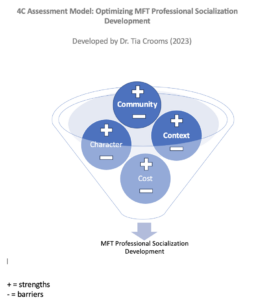
4C Assessment Model Systemic Questions
Community
- Does the supervisee live in an area where there is an active MFT chapter, network, or support group?
- How engaged is the supervisee with other MFT professionals or systemic thinkers?
- How much does the supervisee stay up to date and informed of relevant MFT literature, AAMFT latest news and developments, and global news that impact the field and their work as MFTs?
Character
- Does the supervisee consider themselves an introvert, extrovert, or something else? >How might this impact their level of engagement in the field?
- What is the supervisee’s level of readiness to engage in larger professional systems on a scale of 0 to 10? How can this rating guide supervision tasks?
- What does the supervisee believe about their level of experience? Does their self-assessment serve as a strength or barrier to engaging more in the field? (i.e. imposter syndrome, social comparison theory, circle of security, etc.)
- Are professional skills and relationship development within the field included in their short or long-term professional goals? How can this be encouraged in supervision?
- What is the supervisee’s understanding of their role in larger professional spaces within the field? (i.e. local MFT organizations, AAMFT, etc.)
- How much was MFT professional identity and socialization development skills discussed and integrated into their educational program, past clinical and supervision training?
- What feedback has the supervisee received from other professionals related to their skills and development that is relevant to consider? (i.e. professors, previous supervisors, professional mentors, colleagues, peers, etc.)
Context
- Does the supervisee’s work setting include other MFTs or systems thinkers?
- How might this impact their professional identity and socialization?
- Does their work setting welcome systemic thinking and systemic approaches? If so, in what way?
- Does their work setting include work with couples and families, or primarily individuals? >How might this be impacting the supervisee’s systemic practices and identity?
Cost
- Does the supervisee have the financial means or support to afford professional memberships and conferences related to the work of MFTs?
- Does the supervisee have the needed resources and/or family support to travel for professional activities?
- Has the supervisee shown interest in getting more connected and involved in the profession, but covertly or overtly expressed finances as a barrier?

Voices from the field: Feedback on the 4C Assessment Model
“[It] Can be used to determine goodness of fit for supervisees as well.”
“The model can be used as a framework for supervisors to consider when assessing and supporting supervisee MFT identity development.” –AAMFT Supervisor Candidate
“Character refers to the intrinsic feelings of the supervisee about themselves as a therapist, specifically where they are on the spectrum of imposter syndrome, their understanding of their role as a systemic therapist in professional spaces, and readiness to engage other professionals. Context refers to assessing the setting in which the trainee is practicing, including whether the supervisee is surrounded by other systemic-minded professionals, whether their work setting encourages or supports systemic models, and working with the full family system. If you are not able to practice systemically, this can hinder your identity development as a systems-trained clinician. Cost includes the practical costs that supervisees encounter, which can often be a barrier to staying connected to the profession. Here you are assessing whether the trainee sees cost as a barrier to staying engaged in the association or participation in continuing education with other systemic professionals. Finally, community refers to the supervisee’s engagement with the MFT community, both locally and the national organization. This can be impacted by context, but even in the most supportive context, does the supervisee take advantage of their access to a network.” –AAMFT Supervisor Candidate
“Dr. Tia Crooms (2023) has also created and identified the Four C’s Processing Model that points to the above purposes and goals through a systemic lens in the development of the professional identity of the supervisee: community, character, cost, and context. These sections portray the significance as to the impact therapists and supervisors have within the environment, field of marriage and family therapy, and within self. This will also be a helpful tool for me to use with my supervisees to aid in their development, specifically the follow up questions listed per category. In using the Four C’s Processing Model, I can ensure the character of my supervisees are supported, context is expanded and understood in a systemic way, cost is not a barrier to effectiveness and learning, and connection to networking and community is promoted.” –AAMFT Supervisor Candidate

Dr. Tia Crooms, LMFT, earned her doctorate degree from North Carolina State University, completed her MA in Marriage and Family Therapy from Mercer University School of Medicine, and completed her BA in Psychology from the University of North Carolina at Chapel Hill. Dr. Crooms is presently an Assistant Professor in the Marriage and Family Sciences program at National University, where she teaches courses, leads a clinical internship group, and serves as a faculty mentor. Dr. Crooms is an AAMFT Professional member holding the Clinical Fellow and Approved Supervisor designations, and also serves on the Leadership Development & Recruitment Committee (LDRC) of AAMFT, as well as a supervision course instructor for AAMFT. Additionally, Dr. Crooms serves as an active AAMFT supervisor for clinicians and a supervisor mentor for supervisor candidates in training. Dr. Crooms is also CEO and founder of Systemic Supervision Training Center dba Safe Space Therapy Center. Although Dr. Crooms enjoys providing therapy for a variety of clinical needs, her specialty area of clinical practice is couples therapy using the Gottman Method for Couples Therapy. Dr. Crooms enjoys reading, traveling around the globe, and fun family adventures.
Other articles

Perspectives
High-Conflict Communication in Blended Families: Helping Everyone Feel Heard Without Escalating Conflict
After a divorce or separation, clients can feel as though everything is a fight. It isn’t that they are high-conflict people. More often, they have developed a pattern of communication in which conflict is expected before the conversation even begins. Now add the complexities of a second relationship and additional children, and the dynamics of any household can become truly complicated.
Amanda D. Singer, JD

Special to This Issue
Systemic Training in an Era of Anti-DEI Policies: Utilizing Three Systemic Pillars to Guide CFT Program Governance
Recent actions have affected DEI practices in higher education, with the February 14, 2025, Dear Colleague Letter (U.S. Department of Education, 2025) increasing scrutiny and causing uncertainty for programs focused on inclusion. Some departments face program threats, while others and institutions experience system-wide anxiety.
Mary R. Nedela, PhD, M. Evan Thomas, PhD, Deneisha Scott-Poe, PhD, & Sarah Powers, EdD

Systemic World
When the Homeland Is on a Screen: How Geopolitical Trauma Affects Children in Diaspora Families
At dinner, a father’s hand pauses midair. His phone lights up with a video from a street he once walked as a teenager in Tehran. Smoke fills the frame. Someone is shouting. He leans closer without realizing his daughter is not watching the footage. She is watching his face. In the car after school, a mother lowers the volume on a Farsi news broadcast the moment her son opens the door. She asks about homework in a voice that is just slightly too bright.
Bahareh Sahebi, PsyD